
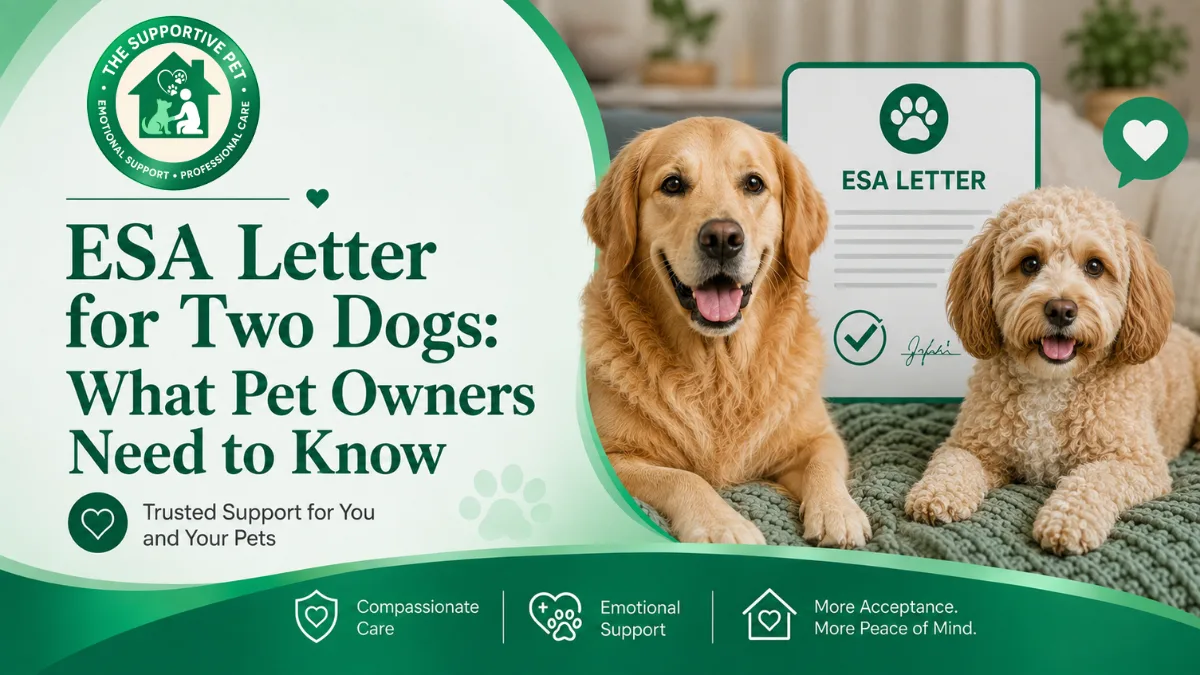
Can I have two dogs as emotional support animals?
Yes. The Fair Housing Act does not limit emotional support animals to one per person. If two dogs genuinely contribute to managing your mental health condition, both can qualify as ESAs. A licensed mental health professional must evaluate your situation and determine that both dogs provide therapeutic benefit related to your condition.
Medical Disclaimer: This article is for informational purposes only and does not constitute medical or legal advice. Consult a qualified mental health professional before making decisions about your care. If you or someone you know is in crisis, call or text 988 (Suicide & Crisis Lifeline, available 24/7).
Can Both of Your Dogs Be Emotional Support Animals?
Yes. The Fair Housing Act does not limit emotional support animals to one per person. If two dogs genuinely contribute to managing your mental health condition, both can qualify as ESAs under FHA housing protections. The requirement is clinical: a licensed mental health professional must evaluate your situation and determine that both animals provide therapeutic benefit related to a qualifying condition.
HUD guidance explicitly acknowledges that an individual may need more than one emotional support animal. What matters is the genuine therapeutic relationship - not the count.
What Clinicians Look for When Evaluating Two Dogs
When a clinician reviews your case for two dogs, they apply the same clinical criteria they would for one dog - but to each animal individually:
- A genuine mental health condition that substantially limits a major life activity. Anxiety, depression, PTSD, bipolar disorder, OCD, ADHD, and many others qualify. See our qualifying conditions guide for a full list.
- A credible therapeutic nexus for each dog. How does each dog specifically help you manage your condition? This should be distinct from general companionship - think in terms of specific situations where each dog's presence reduces symptoms.
- That the request is reasonable given your housing situation. Two large dogs in a studio apartment may raise questions from a housing provider, though the clinician's role is clinical, not logistical.
If your two dogs serve different therapeutic functions - one dog grounds you during anxiety episodes, the other motivates you to maintain daily routine - articulating those distinctions in your intake strengthens your evaluation significantly.
Do You Need Two ESA Letters for Two Dogs?
No - the law does not require two separate letters. One properly written letter that names both dogs, describes their therapeutic roles, and includes the clinician's license information satisfies the FHA documentation requirement.
The reason many two-dog households end up with two letters is that most ESA services build their evaluations around one animal per letter. If you use one of those services, you would need two separate evaluations and two fees.
The Supportive Pet's evaluation covers up to two animals on one letter. If the clinician determines both dogs are clinically appropriate, both are named on the same letter at no additional per-dog charge. Learn more about our two-pet ESA letter.
How to Describe Two Dogs in Your ESA Intake
When completing your intake assessment, include specific information about each dog:
- Each dog's name, breed, age, and size - your landlord will need to identify each animal
- The specific way each dog helps you - not that they are companions, but the concrete therapeutic functions each one serves (grounding during anxiety, encouraging routine, interrupting harmful thought patterns, providing physical contact during panic attacks)
- How long each dog has been part of your mental health management - an established relationship carries more clinical weight than a recently acquired animal
The more specific and honest your intake, the stronger your clinical evaluation will be. A clinician who can clearly see that both dogs serve genuine therapeutic functions is much more likely to include both on a single letter.
Presenting Your ESA Letter to Your Landlord for Two Dogs
When you submit an ESA letter identifying two dogs, your landlord must consider the accommodation request for both animals. Under the FHA, they cannot:
- Apply breed restrictions or weight limits to either ESA dog
- Charge a pet deposit or pet fee for either dog
- Require your dogs to wear identifying vests or gear
- Deny your request based on a no-pets policy alone
Landlords can ask reasonable questions about each dog's behavior and direct threat history. A well-written letter that identifies both dogs directly addresses those questions. For a full explanation of your FHA rights, see our ESA letter for housing guide.
If your landlord denies your request without a lawful reason, you can file a complaint with HUD. The Supportive Pet provides free landlord dispute support for every letter we issue.
What If One Dog Qualifies and the Other Does Not?
If the clinician evaluating your case determines that one of your dogs has a strong therapeutic nexus but the other does not, they will issue a letter for the qualifying dog only. This is the correct clinical outcome - and it is exactly what makes the letter legally defensible.
An ESA letter that simply includes all your pets without individual clinical justification is a document mill product. Landlords increasingly know how to identify these letters, and they will not hold up under scrutiny.
If your second dog does not qualify at this time, the right path is to work with a licensed therapist over time to develop a documented therapeutic relationship with that dog, then revisit the evaluation at your next renewal.
ESA Dogs vs. Psychiatric Service Dogs: Two Different Protections
If one of your dogs has been trained to perform specific psychiatric tasks - responding to anxiety symptoms, waking you from nightmares, performing deep pressure therapy, or similar trained behaviors - they may qualify as a Psychiatric Service Dog rather than an ESA. PSDs carry full ADA public access rights (restaurants, stores, hotels, transportation) in addition to FHA housing rights.
If one dog performs trained tasks and the other provides general support, you might have one PSD and one ESA - both documented through The Supportive Pet. The evaluations are separate but the process is the same.
Related Guides for Multi-Pet Households
For the main guide covering all two-pet situations: Do You Need Two ESA Letters for Two Pets?
For mixed-species households: ESA Letter for a Dog and Cat.
To start your assessment: ESA Letter for 2 Pets - The Supportive Pet.
For ESA pricing: pricing page. For your housing rights: ESA letter for housing.
The Legal Framework for Multiple ESA Dogs
The Fair Housing Act does not cap the number of emotional support animals a person can have. The standard is reasonable accommodation — meaning the accommodation must be related to your disability, necessary for equal opportunity to use the dwelling, and not impose an undue hardship or fundamentally alter the housing program.
Having two ESA dogs is reasonable accommodation when your licensed clinician documents that both animals are part of your treatment plan. The critical element is the clinical documentation, not a numerical limit.
Making the Case for Two ESA Dogs
A strong two-dog ESA accommodation request typically includes documentation explaining:
- Distinct functions: Each dog provides different therapeutic support — for example, one dog alerts to panic attacks (trained response) while the other provides companionship during depressive episodes
- Clinical history: The duration of the relationship with each animal and how each has contributed to your mental health management over time
- Comorbid conditions: If you have multiple mental health diagnoses, each dog may address a different condition or symptom cluster
- The cumulative benefit: Why one dog alone is not sufficient for your treatment needs
How Landlords Must Evaluate Two-Dog ESA Requests
Landlords must make an individualized assessment. They cannot deny based on a blanket "one pet per unit" policy. However, they can consider:
- Whether the unit is of adequate size for two dogs
- Whether two dogs would create noise, sanitation, or damage risks materially different from one
- Whether the combination poses any documented direct threat
Each of these must be assessed based on your specific animals, not hypothetical scenarios. If your two dogs are small, well-behaved, and your unit is adequate, the individualized assessment should result in accommodation.
Practical Management of Two ESA Dogs in a Rental
Documentation Best Practices
- Obtain a single ESA letter covering both dogs explicitly, with the clinician's explanation of each dog's role in your treatment
- Maintain vaccination and licensing records for both dogs
- Submit one accommodation request covering both dogs simultaneously rather than sequential requests
Tenant Best Practices
- Establish a clear waste management routine and follow it — the most common multi-dog complaint is inadequate waste pickup
- Address noise proactively — two dogs can be noisier than one; training for quiet on command is a practical management tool
- Ensure both dogs are licensed, vaccinated, and compliant with local ordinances
Frequently Asked Questions: Two ESA Dogs
Can a landlord require me to prove I need two dogs rather than one?
Yes. A landlord may request sufficient documentation to understand the disability-related need. Your clinician's letter should address why two dogs are part of your treatment plan. You do not need to prove your diagnosis, but you should have documentation that addresses the necessity of two animals rather than one.
What if one of my two dogs has a breed restriction issue?
ESA protection overrides breed restrictions for both dogs if both are covered by your ESA documentation. A landlord cannot refuse one dog on breed while accepting the other — both must be evaluated individually under the direct threat standard, not by breed profile.
I adopted a second dog as an ESA after my landlord approved the first. What is the process?
Submit a new reasonable accommodation request for the second dog. Include updated ESA documentation from your clinician covering both animals. Your landlord must consider the new request; the prior approval of the first dog does not automatically extend to the second, but it does establish that you have a documented disability and prior accommodation history.
Can my landlord charge different deposits for two ESA dogs versus one?
No. The prohibition on pet fees for ESAs applies regardless of the number of ESA animals. If both dogs are documented ESAs, neither is subject to any pet-related fees or deposits. The landlord retains the right to deduct actual damage at move-out from your standard security deposit.
Frequently Asked Questions
Can I have two dogs as emotional support animals?
Yes. The Fair Housing Act does not limit emotional support animals to one per person. If two dogs genuinely contribute to managing your mental health condition, both can qualify as ESAs. A licensed mental health professional must evaluate your situation and determine that both dogs provide therapeutic benefit related to your condition.
Do I need two ESA letters for two dogs?
No - not legally. One ESA letter that identifies both dogs by name and documents their therapeutic roles satisfies the FHA documentation requirement. Whether you receive one letter or two depends on the service you use. Most providers issue one letter per dog. The Supportive Pet allows eligible clients to include up to two dogs on one letter.
Can a landlord apply breed restrictions to ESA dogs?
No. Breed restrictions do not apply to documented ESAs under the Fair Housing Act. Your landlord cannot deny your ESA request based on your dog's breed, weight, or size. If they attempt to, you can file a complaint with HUD or your state's fair housing agency.
How do I describe two dogs in my ESA intake form?
Include the name, breed, age, and size of each dog. Then describe the specific therapeutic role each one plays in managing your mental health condition - concrete examples of how each dog helps you during specific situations are more persuasive than general statements about companionship. The more specific and honest your intake, the stronger your clinical evaluation will be.
What if only one of my dogs qualifies?
If the evaluating clinician determines that one dog has a strong therapeutic nexus but the other does not, they will issue a letter for the qualifying dog only. This is the correct clinical outcome. An ESA letter that includes dogs without proper clinical justification is not legitimate and will not hold up to scrutiny.
See our articles highlighted in Google Search
Add The Supportive Pet as a preferred source - your results, your way.