
What ESA law applies in Florida?
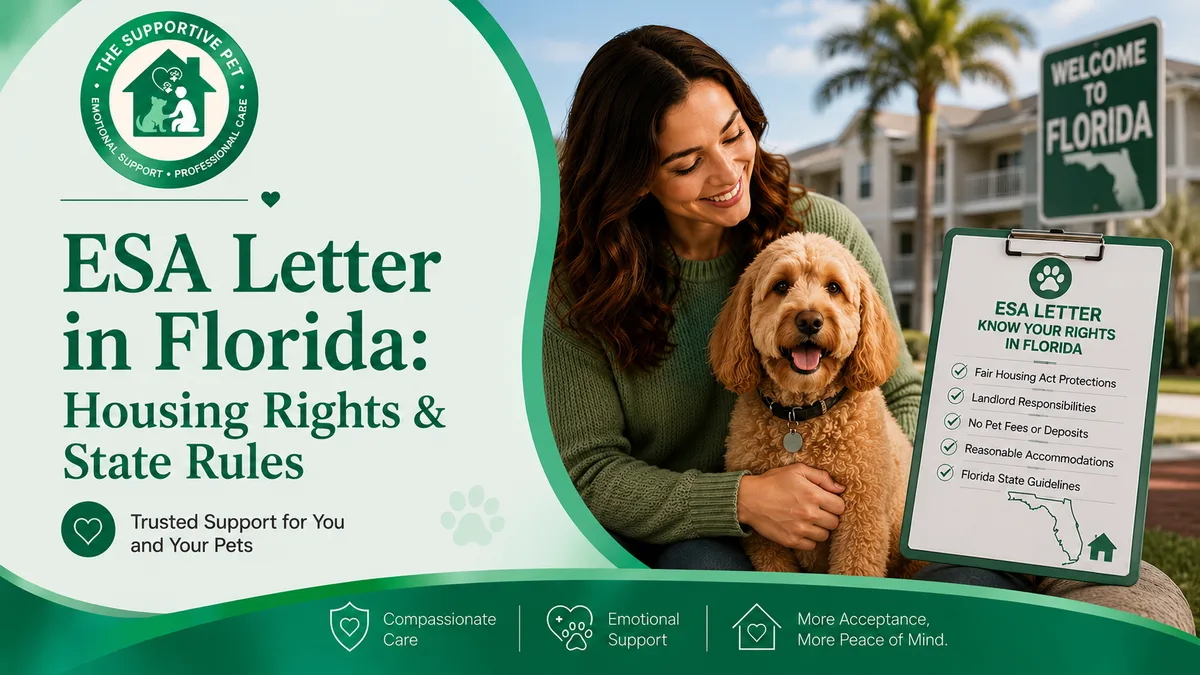
Florida residents are protected by two laws: the federal Fair Housing Act (which applies in all 50 states) and the Florida Fair Housing Act (Chapter 760, Florida Statutes), which mirrors and enforces the same protections at the state level. Florida also enacted SB 1084 (effective 2020), which makes it a second-degree misdemeanor to knowingly provide false documentation for an ESA. This law reinforces the importance of getting a legitimate letter from a real licensed clinician.
Key Takeaways
- Florida's Fair Housing Act mirrors federal FHA protections - landlords statewide must grant reasonable accommodation for documented ESAs.
- Florida SB 1084 makes it a second-degree misdemeanor to knowingly provide false or fraudulent documentation for an ESA - reinforcing the importance of getting a legitimate letter.
- Florida has a large veteran and retiree population; PTSD, anxiety, and depression are among the most common qualifying conditions for Florida ESA letters.
Medical Disclaimer: This article is for informational purposes only and does not constitute medical or legal advice. Consult a qualified mental health professional before making decisions about your care. If you or someone you know is in crisis, call or text 988 (Suicide & Crisis Lifeline, available 24/7).
Florida is one of the few states with its own ESA anti-fraud law on top of the federal Fair Housing Act. Florida SB 1084 made it a second-degree misdemeanor to fraudulently misrepresent an animal as an ESA - which means Florida landlords are more vigilant about documentation than in most states. For legitimate ESA owners, this actually strengthens your position: a properly documented letter from a real licensed clinician is harder for a Florida landlord to challenge. This guide explains everything Florida renters need to know about ESA housing rights in 2026.
ESA Letters in Florida: Two Overlapping Frameworks
Florida ESA owners are protected by two legal frameworks:
- Federal Fair Housing Act - applies in all 50 states, requires landlords to grant reasonable accommodation for documented ESAs
- Florida Fair Housing Act (Chapter 760, Florida Statutes) - mirrors federal FHA protections at the state level, enforced by the Florida Commission on Human Relations
Together, these frameworks protect Florida renters in apartments, condos, HOA communities, mobile home parks, and most other residential housing. Florida has one of the largest rental markets in the US - Miami, Orlando, Tampa, Jacksonville, and Fort Lauderdale all have large apartment communities where ESA letters are commonly used.
Florida SB 1084: The Anti-Fraud ESA Law
Florida enacted SB 1084 (effective 2020) to address fraudulent ESA documentation. The law makes it a second-degree misdemeanor to:
- Knowingly provide false or fraudulent documentation to obtain ESA housing accommodation
- Misrepresent a pet as an emotional support animal
- Knowingly use false ESA documentation to secure housing benefits
Penalties include up to 60 days in jail and a $500 fine. For legitimate ESA owners with a real letter from a licensed clinician, SB 1084 has no impact - it targets fraud, not genuine ESA accommodation requests. The law reinforces why getting your letter from a real licensed clinician (not a letter mill or instant service) is critical in Florida.
What Florida Landlords Must Do
Under the federal FHA and Florida Fair Housing Act, Florida landlords must:
- Grant reasonable accommodation for tenants with a valid ESA letter from a licensed clinician
- Waive pet fees and pet deposits for documented ESAs
- Respond to accommodation requests within a reasonable time
- Accept telehealth-issued ESA letters (online evaluations are valid in Florida)
What Florida Landlords Cannot Do
- Enforce breed, weight, or size restrictions against a documented ESA
- Charge pet deposits or pet rent for a documented ESA
- Demand your specific psychiatric diagnosis
- Require ESA registration, certification, or ID cards
- Deny accommodation based on their building's no-pet policy
- Retaliate against you for making an accommodation request
Florida's Veteran and Senior ESA Community
Florida is home to one of the largest veteran populations in the US and a significant retiree community. PTSD, service-related anxiety, and depression are among the most common qualifying conditions for ESA letters in Florida. For veterans, see our guide on ESA letters for veterans. For seniors in assisted living and housing, see our guide on ESA letters for seniors.
Florida's condo and HOA communities are also common settings for ESA disputes - homeowners associations must comply with the FHA just as landlords do. See our guide on ESA letters for HOA residents.
Florida Rental Markets and ESA Demand
Miami-Dade and Broward County
South Florida's rental market is among the most competitive in the country. Miami and Fort Lauderdale apartment communities frequently charge $300-$500 in pet deposits and $50-$100 per month in pet rent - fees that documented ESA owners are legally exempt from. South Florida landlords tend to be familiar with ESA letters given the high demand, but also scrutinize documentation more carefully following SB 1084.
Orlando and the Central Florida Market
Orlando's rental market has grown significantly with the tech and hospitality sectors. Many Orlando apartment complexes have strict no-pet or limited-pet policies due to their community size and amenity costs. Under the FHA and Florida Fair Housing Act, a valid ESA letter from a licensed Florida clinician overrides these policies at all Orlando properties covered by federal law.
Tampa Bay and the Gulf Coast
Tampa, St. Petersburg, and Sarasota have seen rapid rent increases alongside stricter pet policies. ESA owners in the Tampa Bay area should present their letter in writing, keep copies of all correspondence, and be prepared to reference the FHA and Florida Fair Housing Act specifically - larger Tampa property management companies may have dedicated teams for processing accommodation requests.
If Your Florida Landlord Denies Your ESA
If your Florida landlord denies your accommodation without a valid legal reason, file a complaint with:
- Florida Commission on Human Relations: fchr.state.fl.us - Florida's state-level fair housing enforcement agency
- HUD: hud.gov/fairhousing - federal enforcement option
The Supportive Pet provides free landlord dispute support for all letters we issue - our team can help you draft a formal response to an improper denial before you need to file a complaint.
How to Get Your Florida ESA Letter
Florida residents need a letter from a Florida-licensed mental health professional. Florida does not have California's 30-day waiting period requirement - a fast evaluation with a Florida-licensed clinician is fully compliant with Florida law.
Florida Condo Associations and HOAs
Florida Has One of the Highest HOA Densities in the US
Florida leads the nation in HOA-governed communities. Virtually every major residential development in Florida - from Miami Beach condos to Boca Raton retirement communities to Orlando master-planned communities - operates under HOA rules. Under the FHA and Florida Fair Housing Act, Florida HOAs must provide reasonable accommodation for ESAs regardless of their community pet policies. A valid ESA letter overrides HOA breed restrictions, size limits, pet fees, and no-pet rules throughout Florida.
55+ Communities and ESA Rights
Florida has a significant number of age-restricted 55+ communities. These communities qualify for an exemption from some FHA requirements (the "housing for older persons" exemption), but this exemption does not extend to the disability accommodation provisions. Residents of Florida 55+ communities retain full ESA housing rights under the FHA - community management must still honor valid ESA letters.
Start your Florida ESA evaluation at The Supportive Pet. Our Florida-licensed clinicians conduct genuine clinical evaluations, and most Florida patients receive their letter the same business day.
Frequently Asked Questions
What ESA law applies in Florida?
Florida residents are protected by two laws: the federal Fair Housing Act (which applies in all 50 states) and the Florida Fair Housing Act (Chapter 760, Florida Statutes), which mirrors and enforces the same protections at the state level. Florida also enacted SB 1084 (effective 2020), which makes it a second-degree misdemeanor to knowingly provide false documentation for an ESA. This law reinforces the importance of getting a legitimate letter from a real licensed clinician.
What does Florida SB 1084 require?
Florida SB 1084 makes it illegal to knowingly misrepresent a pet as an emotional support animal, or to provide or use false documentation to obtain ESA housing accommodation. The law imposes criminal penalties (second-degree misdemeanor, up to 60 days in jail and a $500 fine) on fraudulent representations. For legitimate ESA owners with real documentation from a licensed clinician, SB 1084 has no impact - it targets fraud, not legitimate ESA rights.
Can Florida landlords deny my ESA?
Florida landlords can only deny an ESA accommodation if the specific animal poses a direct, documented threat to others or would cause substantial property damage. No-pet policies, breed restrictions, weight limits, and pet fees do not apply to documented ESAs under the Florida Fair Housing Act and federal FHA. If your Florida landlord denies your valid ESA request, you can file a complaint with the Florida Commission on Human Relations (fchr.state.fl.us) or with HUD.
Does my Florida ESA letter need to come from a Florida-licensed clinician?
Yes. Your ESA letter must come from a mental health professional who holds an active Florida license. Florida-licensed credentials include LCSW (licensed through the Florida Department of Health, Board of Clinical Social Work), LMHC, LMFT, licensed psychologist (Florida Board of Psychology), and Florida-licensed psychiatrists. The Supportive Pet connects Florida residents with Florida-licensed clinicians for fast online evaluations.
How do I file an ESA housing complaint in Florida?
Florida residents can file a housing discrimination complaint with: (1) Florida Commission on Human Relations (fchr.state.fl.us) - Florida's state-level fair housing enforcement agency; (2) HUD (hud.gov/fairhousing) - federal enforcement option. The Florida Commission on Human Relations investigates fair housing complaints and can award damages for unlawful housing discrimination. The Supportive Pet provides free landlord dispute support before formal complaints are needed.
See our articles highlighted in Google Search
Add The Supportive Pet as a preferred source - your results, your way.