
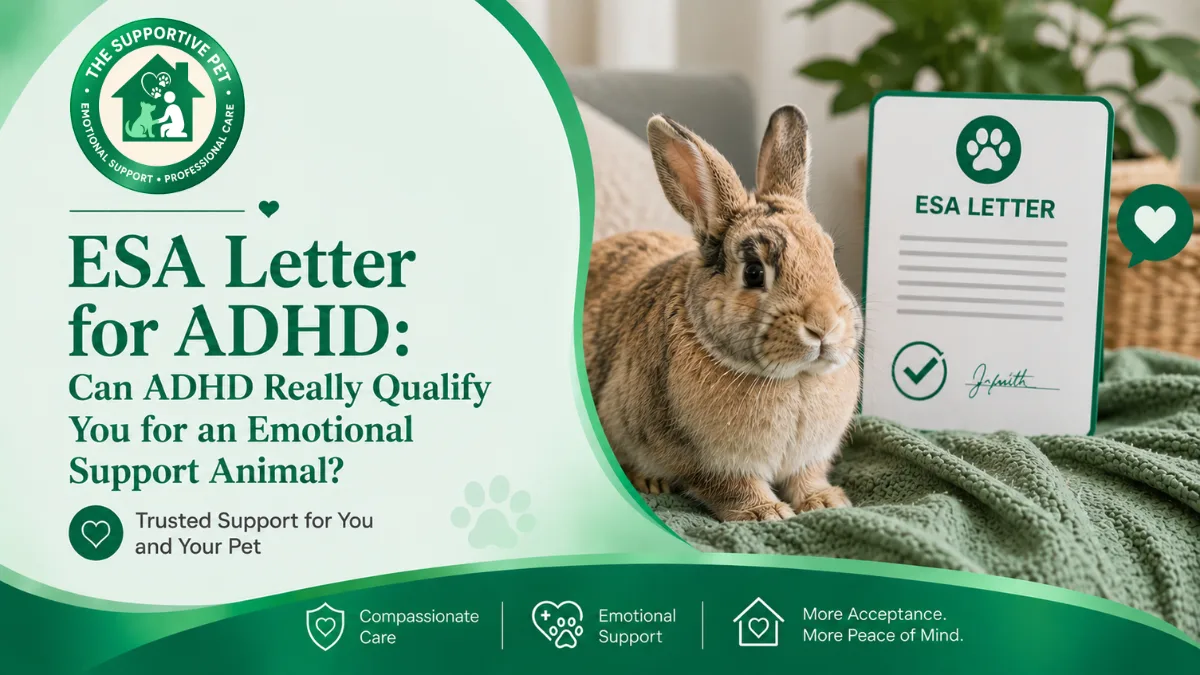
Does ADHD qualify for an ESA letter?
ADHD can qualify for an ESA letter when it substantially limits one or more major life activities. The FHA uses a broad disability definition that includes ADHD when it meaningfully impairs concentration, organization, work, sleep, or interpersonal relationships. Mild ADHD that is well-managed may not meet the threshold, but moderate to severe ADHD that significantly affects daily functioning frequently qualifies.
Key Takeaways
- ADHD qualifies as a disability under the FHA when it substantially limits concentration, organization, or other major life activities - an ESA letter formalizes this clinical finding.
- Animals provide external routine cues, sensory input, and motivational anchors that many adults with ADHD find clinically helpful for daily functioning and executive function challenges.
- The letter must specify how your ADHD affects you and how an ESA addresses that need - vague letters are the ones landlords most often successfully challenge.
Medical Disclaimer: This article is for informational purposes only and does not constitute medical or legal advice. Consult a qualified mental health professional before making decisions about your care. If you or someone you know is in crisis, call or text 988 (Suicide & Crisis Lifeline, available 24/7).
ADHD - Attention Deficit Hyperactivity Disorder - is a DSM-5 recognized neurodevelopmental condition that can qualify for ESA accommodation under the Fair Housing Act when it substantially limits one or more major life activities. For adults with ADHD who struggle with executive function, emotional regulation, and the chronic stress of managing daily demands, an emotional support animal can provide structure, grounding, and emotional relief that measurably supports their functioning. Here is what you need to know about getting an ESA letter for ADHD.
ADHD and the FHA Disability Standard
ADHD is a DSM-5 brain-based condition that can qualify as a disability under the Fair Housing Act. The FHA does not require a specific type of diagnosis. It requires that the condition greatly limit one or more major life activities.
ADHD affects several major life activities at once: concentrating, organizing, completing tasks, managing time, managing feelings, and sleeping. When these problems are major enough to meaningfully disrupt daily functioning, ADHD meets the FHA threshold.
When ADHD Qualifies - and When It May Not
Not every ADHD case qualifies for ESA paperwork. The determining factor is substantiality:
- More likely to qualify: Moderate to severe ADHD that greatly impairs work, school, or self-care. This includes ADHD with major co-occurring anxiety or depression, or ADHD poorly controlled despite medicine or therapy.
- Less likely to qualify: Mild ADHD that is well-managed with medicine. Or ADHD that causes some trouble but does not greatly limit daily life.
A licensed clinician will make this determination based on your individual case - not a general assessment of whether ADHD "counts."
How Animals Support ADHD care
The therapeutic benefit of animals for ADHD care is supported by clinical literature and consistent patient experience. The NIMH defines ADHD as impairing attention, impulse control, and activity care. These are areas where animal interaction shows real benefit:
- External structure: Dogs especially impose a firm daily routine: morning walks, feeding times, and evening play. This makes up for ADHD's loss of time sense.
- Dopamine regulation: Physical activity from caring for a dog boosts the brain chemicals that ADHD drugs target.
- Emotional regulation: Animals provide a calming, patient presence that helps interrupt the frustration cycles and mood swings common in ADHD.
- Focused attention: Interaction with an animal provides a naturally engaging, low-demand focus activity that can reset attention without the distress of forced concentration.
- Reduced co-occurring anxiety: Many people with ADHD have major anxiety; the calming effects of animal interaction address both conditions at once.
The review Process for ADHD
When you apply for an ESA letter through The Supportive Pet, the licensed clinician will review your ADHD symptoms and history. Be prepared to describe:
- How your ADHD affects specific daily tasks - work deadlines, household maintenance, relationships, sleep.
- Whether you have tried medication, therapy, or other care strategies.
- The specific ways your animal helps you manage your ADHD symptoms.
- How your functioning changes with versus without your animal.
Be as specific as you can. Vague claims like "my dog calms me down" are hard to use. Stronger paperwork sounds like this: "My dog's morning walk is the only thing that gets me out of bed." That level of detail builds a solid clinical basis for your letter.
Housing Rights Your ESA Letter Provides
With a valid ESA letter, your landlord must allow your emotional support animal. This applies regardless of breed, size, or no-pet rules. They also cannot charge a pet deposit. This applies to apartments, condos, and most rental homes. For a full explanation of your rights, see our ESA housing rights guide.
From the Clinician
ADHD clients often arrive at their ESA review expecting me to ask whether their dog "distracts" them from their symptoms. That is not what I'm looking for. What matters is evidence that the animal creates reliable behavioral structure that ADHD itself prevents.
Strong paperwork describes functional outcomes, not feelings. One client put it clearly: "My morning walk with my dog is the only thing that consistently activates me before noon - without it, I don't start my day until 2pm." That is a measurable daily impact.
The NIMH identifies executive function problem as central to ADHD. Animals that impose firm daily structure address precisely that problem.
Client scenario: A graduate student with combined-case ADHD had been on academic probation due to missed deadlines and poor attendance. After documenting that their dog's morning care routine was the only consistent behavioral anchor that got them to class on time, their ESA letter supported a housing right allowing the dog in a no-pet dormitory building. Their next semester GPA improved greatly.
A Fair Look at the Other Side
ADHD-related ESA housing right is sometimes challenged. Landlords may argue that attention problems that appear across many settings, making the disability hard to assess. Strong paperwork addresses this directly. It names the specific executive function impairments ADHD causes - concentration, task starting, organization. It also explains how the animal's structured presence addresses those gaps in the home environment.
Related resources: ESA letter for anxiety · ESA letter for depression · How to get an ESA letter
ADHD and Animals: The Clinical Mechanism
Dopamine and the Human-Animal Bond
ADHD is fundamentally a condition of dopamine dysregulation - the brain's reward system doesn't process this neurotransmitter as efficiently as in neurotypical brains, leading to difficulty sustaining attention and motivation. Research shows that positive human-animal interaction triggers dopamine and serotonin release in both the human and the animal. For ADHD brains, this represents a reliable, consistent source of the neurochemical reinforcement that external tasks often fail to provide. This is why many ADHD individuals find their animal uniquely effective at helping them transition between tasks or return to baseline after overstimulation.
Routine and Executive Function Support
One of the most consistent findings in research on pets and ADHD is the role of animal care routines in supporting executive function. Feeding schedules, walking routines, grooming appointments, and playtime create external structure that ADHD adults often struggle to generate internally. The animal's needs impose gentle, non-punishing deadlines that many ADHD people find easier to honor than self-imposed schedules. Licensed clinicians evaluating ADHD for ESA documentation assess whether this mechanism is present and clinically meaningful for the individual.
ADHD in Adults vs. Children: ESA Letter Differences
Adults with ADHD can obtain ESA letters directly from their own evaluating clinician. For children with ADHD, the process is different: children cannot hold housing leases independently, so the ESA letter would typically be written for the parent or guardian who holds the lease, documenting how the animal supports the family member with ADHD. Clinicians who specialize in ESA documentation can navigate these scenarios - a telehealth evaluation with a licensed mental health professional is the most efficient starting point.
Frequently Asked Questions
Does ADHD qualify for an ESA letter?
ADHD can qualify for an ESA letter when it substantially limits one or more major life activities. The FHA uses a broad disability definition that includes ADHD when it meaningfully impairs concentration, organization, work, sleep, or interpersonal relationships. Mild ADHD that is well-managed may not meet the threshold, but moderate to severe ADHD that significantly affects daily functioning frequently qualifies.
Can adults with ADHD get an ESA letter?
Yes. ESA letters are available to adults of any age with ADHD. Adult ADHD is well-recognized in DSM-5 and commonly impairs executive functioning, time management, emotional regulation, and occupational performance. Adults with ADHD who rely on an emotional support animal to manage their symptoms have a legitimate basis for requesting ESA documentation.
How does a support animal help someone with ADHD?
Animals support ADHD management primarily through routine structure, emotional regulation, and focused attention. The responsibility of caring for an animal creates an external, non-negotiable routine that compensates for ADHD's impairment of internal scheduling. Physical activity from dog walks increases dopamine and norepinephrine - the same neurotransmitters targeted by ADHD medication. Animals also reduce the anxiety and frustration that commonly co-occur with ADHD.
What does a clinician look for when evaluating ADHD for an ESA?
The clinician assesses whether your ADHD substantially limits major life activities, how your animal specifically mitigates those limitations, whether the animal-human relationship is genuinely therapeutic, and whether an ESA recommendation is clinically appropriate for your situation. They will ask about your ADHD symptoms, their severity, and how they affect your daily functioning - at work, home, and in relationships.
See our articles highlighted in Google Search
Add The Supportive Pet as a preferred source - your results, your way.