
Does anxiety qualify for an ESA letter?
Yes. Anxiety disorders - including generalized anxiety disorder (GAD), social anxiety disorder, panic disorder, and separation anxiety - are recognized mental health conditions under DSM-5 that can qualify you for an ESA letter. The key requirement is that your anxiety substantially limits a major life activity, such as sleeping, concentrating, working, or caring for yourself, and that your emotional support animal provides genuine therapeutic benefit related to that limitation.
Key Takeaways
- An ESA letter for anxiety formally documents that your anxiety disorder qualifies you for FHA housing accommodation, signed by a licensed mental health professional.
- Research confirms animal-assisted support reduces cortisol and interrupts anxiety spirals - the calming presence of an ESA is clinically recognized, not just personal comfort.
- Once you have a valid ESA letter, landlords must grant reasonable accommodation and cannot charge a pet deposit for your animal, regardless of breed or size restrictions.
Medical Disclaimer: This article is for informational purposes only and does not constitute medical or legal advice. Consult a qualified mental health professional before making decisions about your care. If you or someone you know is in crisis, call or text 988 (Suicide & Crisis Lifeline, available 24/7).
Does Anxiety Qualify for an ESA Letter?
Yes - anxiety disorders are one of the most common qualifying conditions for an ESA letter. The Fair Housing Act uses a broad definition of disability. It includes any mental or physical impairment that greatly limits a major life activity. This includes general anxiety disorder, panic disorder, social anxiety disorder, and agoraphobia. These often meet that threshold.
What matters is not the diagnosis label alone, but how your anxiety affects your functioning. If your anxiety greatly limits your sleep, work, or daily care, you may qualify. If your animal truly helps manage those limits, you have a strong basis for an ESA letter.
Which Anxiety Conditions Most Commonly Qualify
Clinicians evaluate ESA requests based on DSM-5 criteria. The following anxiety-related diagnoses frequently support ESA letters:
- general Anxiety Disorder (GAD): Persistent, excessive worry that is difficult to control and affects daily functioning.
- Panic Disorder: Recurrent, unexpected panic attacks with ongoing concern about future attacks.
- Social Anxiety Disorder: major fear of social situations that causes avoidance and functional impairment.
- Agoraphobia: Fear and avoidance of situations where escape might be difficult.
- Specific Phobias: Intense, irrational fear of specific objects or situations that causes major distress.
- Anxiety related to PTSD, OCD, or depression: Co-occurring anxiety that greatly limits functioning.
Mild, situational anxiety that does not greatly limit daily life may not meet the clinical threshold. A licensed clinician will make that finding based on your individual case.
How an Emotional Support Animal Helps Anxiety
The real benefit of animals on anxiety is well-noted in clinical literature. The National Institute of Mental Health (NIMH) classifies anxiety disorders as the most common mental health conditions in the U.S., affecting over 40 million adults. Animals - mainly dogs and cats - have been shown to reduce cortisol levels and lower blood pressure. They also boost oxytocin and provide grounding during anxious episodes. For an ESA review, what matters is the specific clinical link between your animal and your condition. How does this particular animal help manage your particular anxiety symptoms?
Common helpful mechanisms include:
- Physical presence stopping a panic attack or anxious spiral.
- Structured daily routine (feeding, walking) that anchors mood and reduces rumination.
- Social facilitation - a dog that makes social interaction less threatening for someone with social anxiety.
- Night-time comfort that improves sleep disrupted by anxiety.
- Grounding through touch during panic or high-stress states.
Research Snapshot: Animal Support and Anxiety
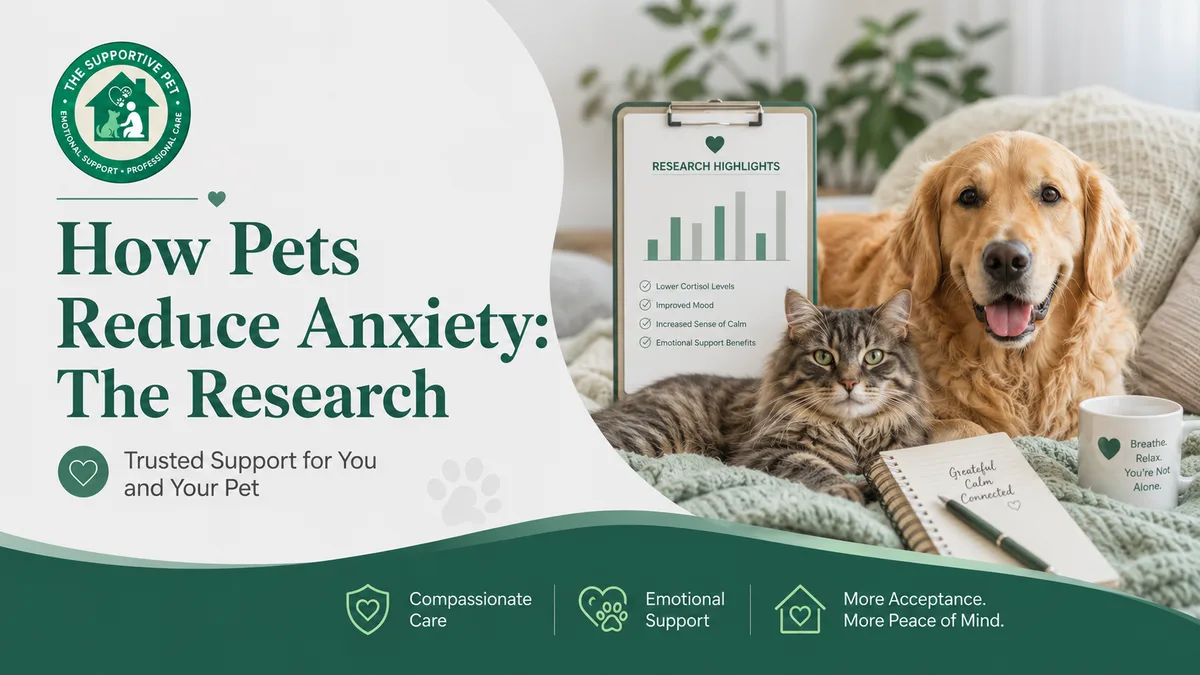
- 40 million US adults live with an anxiety disorder - the most common mental health condition in the country (NIMH, 2023); roughly 1 in 5 adults will experience one in any given year.
- A meta-analysis of 49 randomized studies in Frontiers in Psychology (2019) found animal-assisted interventions reduced self-reported anxiety in 84% of participants compared to control conditions.
- Pet owners demonstrate a 23% lower cortisol response to standardized stress tasks than non-pet owners. Companion animals also produce measurable reductions in blood pressure within 10 minutes of interaction (Allen et al., Journal of Behavioral Medicine).
What to Expect from the Clinical review
The review for an ESA letter is not a formality. A licensed mental health professional - a psychiatrist, psychologist, LCSW, LPC, or LMFT - reviews your case and makes an independent clinical finding. The review typically covers:
- Your anxiety symptoms and how long you have experienced them.
- How your anxiety limits specific major life activities.
- Your current treatment history (therapy, medication, or both).
- The specific ways your animal supports your mental health.
- Whether an ESA recommendation is clinically right for your situation.
At The Supportive Pet, the assessment begins with a brief intake questionnaire followed by a licensed clinician review. If the clinician needs clarification, they will contact you directly. Most letters are delivered the fast.
Your Housing Rights With an ESA Letter for Anxiety
Once you have a valid ESA letter from a licensed clinician, you have the right to request a housing right under the Fair Housing Act. This means:
- Your landlord must consider your request regardless of their no-pet policy.
- They cannot charge a pet deposit or pet fee for your emotional support animal.
- They cannot apply breed, size, or species restrictions.
- They must respond to your request within a reasonable time.
- They cannot retaliate against you for making the request.
For full details on your rights, see our ESA housing rights guide and our page on ESA pet deposit rules.
What the ESA Letter Does Not Cover
An ESA letter for anxiety covers housing under the FHA. It does not provide:
- Airline cabin access - the 2021 DOT rule change removed ESA airline requirements. Only trained Psychiatric Service Dogs fly in-cabin as a right. See our flying with an ESA guide.
- Public access rights - ESAs are not service animals under the ADA and do not have the right to enter restaurants, stores, or other public accommodations.
- Access to all housing - housing with fewer than four units where the owner also lives, some religious organizations, and some private clubs are not covered by the FHA.
If you need broader legal coverage - including public access and airline rights - a Psychiatric Service Dog letter may be more right if your dog performs specific trained tasks.
How to Get Started
If your anxiety greatly limits your daily life and your animal truly helps manage your symptoms, you likely have a strong basis for an ESA letter. Start with The Supportive Pet's free assessment. Describe your anxiety symptoms, how they affect your functioning, and the specific ways your animal provides helpful support. A licensed clinician in your state will evaluate your case - no charge until approved.
From the Clinician
One pattern comes up often in ESA reviews for anxiety. These are people who have lived with anxiety for years and never sought formal records. They often assumed the process would be invasive or uncertain. Many of them already have a strong, real bond with their animal. Their dog has been stopping their panic cycles for years.
When a client's dog settles against their chest at the first sign of a spiral - that is precise. It is a strong description. It gives them something warm and real to focus on before the panic peaks. This kind of detail is what makes an ESA letter strong. Don't just say "it calms me down." Describe exactly when, how, and what it prevents.
Client scenario: A client with panic disorder and a noted pit bull breed restriction applied after their new landlord refused the dog citing a building ban. Their letter described how the dog's physical grounding during 2–3 AM anxiety episodes had reduced ER visits from four in the prior year to zero. The landlord reviewed the paperwork and granted the housing right within five business days.
A Fair Look at the Other Side
ESA housing right requests for anxiety draw more landlord skepticism than almost any other condition - partly because anxiety symptoms aren't visible and partly because the market for invalid letters is largest here. The best counter is a letter that is specific rather than generic. Name the disorder, describe the functional limitations, and explain precisely how the animal addresses those limits. Vague letters invite challenge; credible, provider-specific letters typically resolve without conflict.
Related guides: What is an ESA letter? · How to get an ESA letter · ESA letter cost · What to do if your landlord denies your ESA
Frequently Asked Questions
Does anxiety qualify for an ESA letter?
Yes. Anxiety disorders - including generalized anxiety disorder (GAD), social anxiety disorder, panic disorder, and separation anxiety - are recognized mental health conditions under DSM-5 that can qualify you for an ESA letter. The key requirement is that your anxiety substantially limits a major life activity, such as sleeping, concentrating, working, or caring for yourself, and that your emotional support animal provides genuine therapeutic benefit related to that limitation.
What type of anxiety qualifies for an emotional support animal?
Any clinically diagnosed anxiety disorder can potentially qualify, including generalized anxiety disorder, social anxiety disorder, panic disorder, agoraphobia, specific phobias, and anxiety related to other conditions like PTSD or OCD. The clinician evaluating you will assess the severity of your symptoms and the degree to which your animal alleviates them - not just whether you have a diagnosis.
How does a clinician evaluate anxiety for an ESA letter?
A licensed mental health professional reviews your symptom history, how your anxiety affects your daily functioning, and the specific ways your animal provides therapeutic support. They are not diagnosing you for the first time - they are determining whether your documented condition meets the clinical threshold for an ESA recommendation and whether the animal-human relationship is genuinely therapeutic.
Can I get an ESA letter for anxiety online?
Yes. Telehealth evaluations for ESA letters are legitimate and legally recognized under the Fair Housing Act. A licensed mental health professional conducts the evaluation remotely, just as they would in person. What matters is that the clinician is licensed in your state and conducts a real clinical evaluation - not an automated questionnaire.
What housing rights does an ESA letter for anxiety give me?
An ESA letter is a reasonable accommodation request under the Fair Housing Act. Landlords covered by the FHA - which includes most apartments, condos, and rental homes - must consider your request regardless of no-pet policies, breed restrictions, or pet deposit rules. They cannot charge a pet deposit for your ESA, and they cannot deny the request without a legitimate, documented reason.
See our articles highlighted in Google Search
Add The Supportive Pet as a preferred source - your results, your way.