
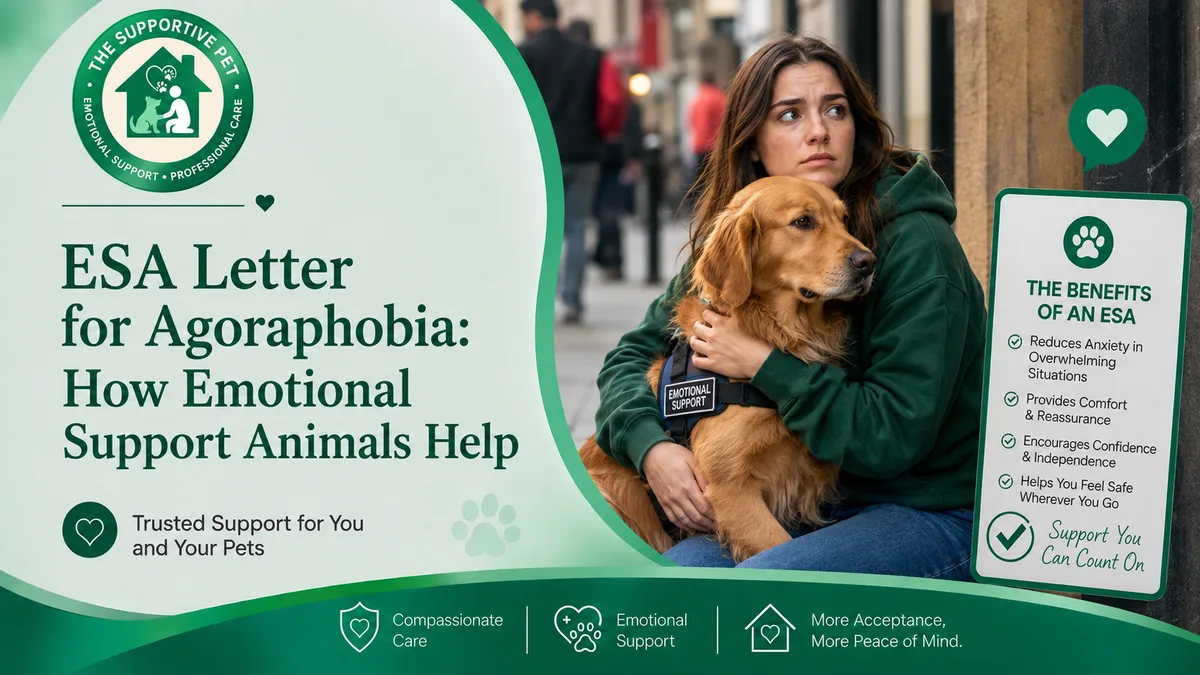
Does agoraphobia qualify for an ESA letter?
Yes. Agoraphobia is a recognized DSM-5 anxiety disorder that can severely limit a person's ability to leave home or be in public spaces. When a licensed clinician determines that an emotional support animal provides therapeutic benefit - which it frequently does for people with agoraphobia - you qualify for an ESA letter and housing protections under the Fair Housing Act.
Medical Disclaimer: This article is for informational purposes only and does not constitute medical or legal advice. Consult a qualified mental health professional before making decisions about your care. If you or someone you know is in crisis, call or text 988 (Suicide & Crisis Lifeline, available 24/7).
Agoraphobia - the fear of situations where escape might be difficult or help unavailable during a panic attack - often leads to severe avoidance of public spaces, crowds, and sometimes leaving home entirely. For people with agoraphobia, the home environment takes on an outsized importance as a safe space, and an emotional support animal can play a central role in making that space feel genuinely secure. If agoraphobia substantially limits your daily life, you may qualify for an ESA letter from a licensed mental health professional.
Does Agoraphobia Qualify for an ESA?
Yes. Agoraphobia is a recognized DSM-5 anxiety disorder characterized by intense fear and avoidance of situations where escape might be difficult or help might be unavailable during a panic attack or other anxiety symptoms. For many people, this means avoiding public transportation, open spaces, enclosed spaces, crowds, or being outside the home altogether.
Because agoraphobia can dramatically limit a person's ability to work, socialize, and participate in daily activities, it frequently meets the Fair Housing Act's definition of a disability. A licensed clinician can issue an ESA letter providing housing protections - including the right to have your emotional support animal in no-pet housing without paying pet deposits or fees.
How Agoraphobia Affects Daily Life
Agoraphobia goes far beyond discomfort in crowds. At its most severe, it can make a person effectively housebound - unable to leave their home, run errands, attend work, or see friends and family. Common impacts include:
- Inability to use public transportation, visit grocery stores, or attend medical appointments
- Social isolation and withdrawal from relationships
- Loss of employment or inability to work outside the home
- Dependency on others for basic needs
- Depression and secondary anxiety that compound the primary condition
- Physical deconditioning from prolonged inactivity
People with agoraphobia often feel ashamed and misunderstood - the condition can be invisible to others who simply see someone who "won't go out." This stigma adds to the psychological burden of an already isolating condition.
How Emotional Support Animals Help with Agoraphobia
An ESA can play a meaningful role in supporting someone with agoraphobia in several ways:
- Providing a calming, grounding presence at home - for someone whose home is their primary refuge, an ESA makes that environment more emotionally supportive and reduces the baseline anxiety that agoraphobia creates
- Motivating graduated outdoor exposure - animals need fresh air, exercise, and outdoor time. For someone with agoraphobia, their ESA's needs can provide a structured, achievable motivation to step outside - a front step today, the sidewalk tomorrow - which is itself therapeutic graduated exposure
- Reducing depression and loneliness - agoraphobia frequently leads to depression due to social isolation. An ESA provides consistent companionship and a sense of purpose
- Creating a sense of safety - having an animal present can reduce hypervigilance and the sense that the environment is threatening, allowing for greater relaxation at home
- Lowering physiological anxiety - interaction with animals is shown to lower cortisol and activate the parasympathetic nervous system, countering the chronic stress state associated with anxiety disorders
Agoraphobia and Telehealth: Getting Help Without Leaving Home
One of the biggest barriers to getting help for agoraphobia is the need to go somewhere to get that help. This is why telehealth is particularly well-suited to people with agoraphobia - and why an online ESA evaluation is an ideal first step.
At The Supportive Pet, our entire evaluation process takes place via secure telehealth - there is no need to go to an office or clinic. A licensed clinician evaluates your needs, and if you qualify, your ESA letter is delivered to your inbox the fast. You never have to leave home.
ESA vs. Psychiatric Service Dog for Agoraphobia
Understanding the difference helps you determine what level of support is most appropriate:
- ESA: Provides emotional comfort and companionship. No specialized training. Protected under FHA for housing. Best for people who need support at home and whose symptoms allow for basic functioning.
- PSD: Trained to perform specific tasks that mitigate agoraphobia - such as performing room checks before a person enters, providing a physical barrier in public spaces, or guiding a person to safety. Protected under ADA for public access. Best for people who need task-specific assistance to function in public. See our PSD letter guide.
A licensed clinician can help you evaluate your specific needs and recommend the appropriate level of support.
How to Get an ESA Letter for Agoraphobia
- Complete the evaluation online - no need to leave home; the entire process happens via secure telehealth
- A licensed clinician evaluates your case - assessing your agoraphobia, its impact on your daily functioning, and whether an ESA provides therapeutic benefit
- Receive your ESA letter the fast - your signed letter with your clinician's license information is emailed to you
- Present it to your landlord - they must accommodate your ESA under the Fair Housing Act
At The Supportive Pet, the evaluation is designed to be as low-stress as possible - a short questionnaire followed by a clinician review, all from the safety and comfort of your home. Once you receive your letter, our ESA apartment guide explains exactly how to submit it to your landlord. View pricing or start your evaluation here.
Agoraphobia, Housing, and ESA Rights
Why Housing Rights Matter More for Agoraphobia
For most ESA owners, housing is one important application of their rights. For people with severe agoraphobia, housing may be everything - it is the primary or only environment in which they function. Having an ESA in their home environment is not an amenity; it is a clinical necessity for their mental health stability. This context strengthens the therapeutic nexus statement in an ESA letter for agoraphobia and is worth communicating to your evaluating clinician so they can document it accurately.
Telehealth Makes Evaluation Accessible for Agoraphobia Sufferers
Getting an ESA letter requires a clinical evaluation, which historically meant going to an in-person appointment - a significant barrier for someone with agoraphobia. Telehealth ESA evaluations completely remove this barrier. A licensed mental health professional can conduct a thorough clinical evaluation via video call, assess your agoraphobia and its severity, determine whether an ESA is clinically appropriate, and issue a compliant ESA letter the fast. You never have to leave your home to get the documentation that protects your right to stay there safely with your animal.
Agoraphobia ESA Letters and Landlord Interactions
If your agoraphobia makes direct landlord confrontations difficult, consider submitting your ESA accommodation request entirely by email. The FHA does not require in-person meetings - a written request with your ESA letter attached is the standard and legally sufficient method. If your landlord requests a meeting, you can decline and handle everything in writing. If they deny your accommodation, you can file a HUD complaint online without ever having to attend an in-person hearing. See our guide on what to do if your landlord denies your ESA.
Frequently Asked Questions
Does agoraphobia qualify for an ESA letter?
Yes. Agoraphobia is a recognized DSM-5 anxiety disorder that can severely limit a person's ability to leave home or be in public spaces. When a licensed clinician determines that an emotional support animal provides therapeutic benefit - which it frequently does for people with agoraphobia - you qualify for an ESA letter and housing protections under the Fair Housing Act.
How does an ESA help someone with agoraphobia?
An ESA provides a consistent, grounding presence that can make venturing outside of comfort zones feel safer. For people with agoraphobia, their ESA can motivate gentle outdoor exposure (needed for the animal's care), provide a calming anchor during anxious moments at home, and reduce the isolation and depression that often accompany agoraphobia.
Can an ESA help me leave the house if I have agoraphobia?
An ESA is not a psychiatric service dog trained for specific tasks, but many people with agoraphobia find that their animal's need for regular outdoor activity creates a structured, achievable reason to leave home - which is itself a form of graduated exposure, one of the most effective therapeutic approaches for agoraphobia.
What is the difference between an ESA and a psychiatric service dog for agoraphobia?
An ESA provides emotional comfort and companionship. A psychiatric service dog (PSD) is trained to perform specific tasks, such as guiding a person safely in public, performing a safety check in a room before the person enters, or providing a physical barrier in crowds. If your agoraphobia requires specific task-based support in public, a PSD may be more appropriate. An ESA is protected under the FHA for housing; a PSD also has ADA public access rights.
Can I get an ESA letter for agoraphobia online?
Yes. Telehealth evaluations are ideal for people with agoraphobia - there is no need to leave home or go to an office. At The Supportive Pet, a licensed clinician evaluates you via a secure telehealth platform and, if you qualify, issues your ESA letter the fast. The entire process can be completed from your home.
See our articles highlighted in Google Search
Add The Supportive Pet as a preferred source - your results, your way.