
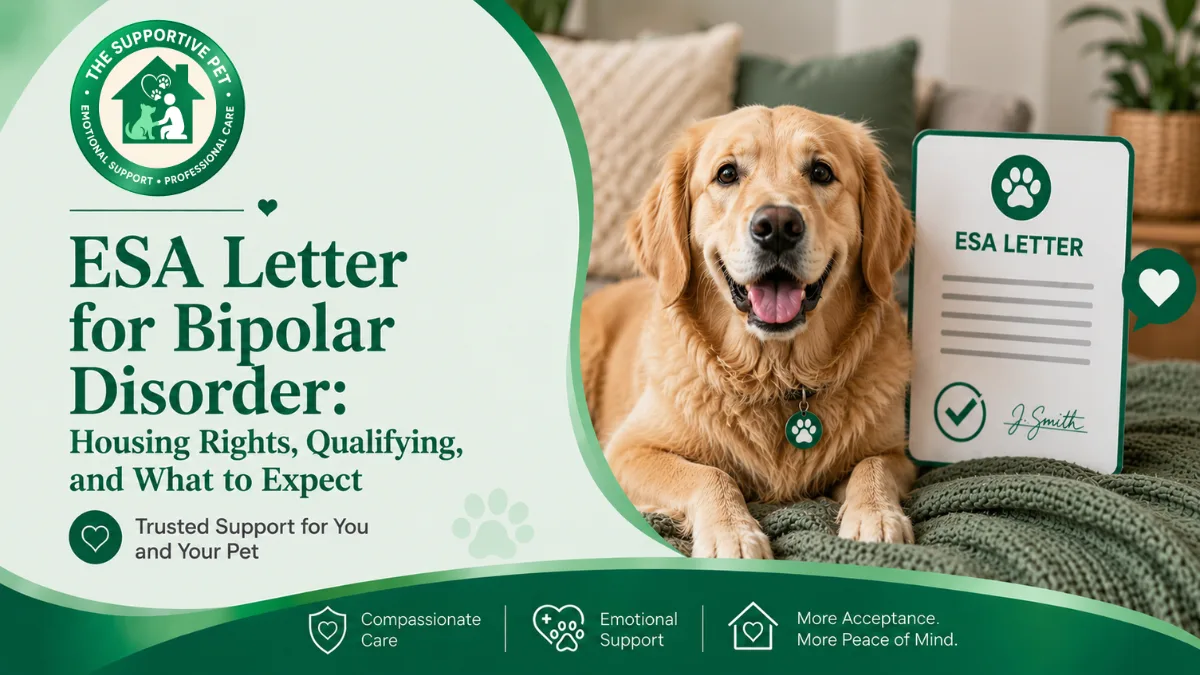
Does bipolar disorder qualify for an ESA letter?
Yes. Bipolar I and Bipolar II disorder are DSM-5 recognized mental health conditions that substantially limit major life activities including sleep, concentration, work, emotional regulation, and maintaining relationships. Both the depressive and manic phases of bipolar disorder impair daily functioning in ways that meet the FHA disability threshold. Whether you are currently in a stable period, a depressive episode, or recovering from a manic episode, your underlying diagnosis supports ESA documentation.
Key Takeaways
- Bipolar disorder qualifies under the FHA when it substantially limits your ability to care for yourself, sleep, or maintain stable housing - an ESA letter documents this formally.
- Animals can provide grounding during mixed or hypomanic episodes and steady companionship during depressive phases - clinicians can speak to this stabilizing role with clinical precision.
- Your ESA letter should reflect your current treatment relationship; a provider who knows your full mood history writes a more credible and defensible letter than a one-time evaluator.
Medical Disclaimer: This article is for informational purposes only and does not constitute medical or legal advice. Consult a qualified mental health professional before making decisions about your care. If you or someone you know is in crisis, call or text 988 (Suicide & Crisis Lifeline, available 24/7).
In Brief
- Bipolar disorder qualifies as a disability under the Fair Housing Act.
- You can request ESA housing rights even during a stable period.
- The FHA evaluates your condition in its untreated state.
- An ESA letter from a licensed clinician supports your housing right request.
- Landlords must allow your ESA regardless of no-pet policies.
- The online review can be done from home - most letters are ready the fast.
Bipolar Disorder and the FHA
Bipolar disorder - both Bipolar I (full manic episodes) and Bipolar II (high-mood and depressive episodes) - is a recognized mental health condition under the Fair Housing Act. The FHA's condition standard requires that a condition greatly limit one or more major life activities. Bipolar disorder affects many areas of life. These include sleep control, mood balance, focus, and work. Social bonds are often affected too.
Importantly, the FHA evaluates condition in its untreated state. Even during stable periods, bipolar disorder is still a condition. Stability depends on ongoing treatment - medicine, therapy, and lifestyle care. The underlying illness has not gone away.
How Animals Support Bipolar Disorder care
The helpful role of animals in bipolar disorder care covers both poles of the condition:
During depressive phases:
- An animal's non-negotiable care schedule provides structure when motivation is absent.
- The social connection with an animal combats the isolation that deepens depression.
- Physical activity from dog care is a natural mood elevator.
During high-mood or manic phases:
- The grounding routine of animal care can help maintain sleep-wake schedules that are critical to mood balance.
- The duty of caring for another living being can serve as an early-warning daily anchor. If routine care is being neglected, it may signal a rising episode.
During stable periods:
- Consistent animal companionship reduces stress, which is a well-documented trigger for both manic and depressive episodes in bipolar disorder.
What the review Covers
The licensed clinician evaluating your ESA request will assess:
- Your bipolar disorder diagnosis and its clinical case.
- How your condition affects major life activities across mood states.
- Your current treatment plan and balance.
- The specific ways your animal supports your mood care and daily functioning.
You do not need to be in an acute episode to apply. The clinician evaluates the ongoing nature of the condition, not just your current state.
Housing Protections Under the FHA
A valid ESA letter for bipolar disorder gives you the right to request a reasonable housing right from your landlord. Your landlord must allow your emotional support animal regardless of no-pet policies, pet deposits, or breed restrictions. They cannot ask for your specific diagnosis or medical records - only confirmation of condition and clinical link.
If your landlord denies your housing right request, see our guide on what to do when a landlord denies your ESA. You can also read about your options for responding to an ESA letter rejection.
Getting Your ESA Letter for Bipolar Disorder
Start with The Supportive Pet's online intake. Describe your bipolar disorder symptoms. Explain how they affect your sleep, mood control, work, and daily life across different mood states. Also note the specific helpful role your animal plays in your mood care. A licensed clinician in your state will review your case and issue your letter the fast if appropriate.
From the Clinician
Bipolar disorder presents a clinical challenge for ESA paperwork. People often apply during a stable period. They worry that their current balance undermines their case. It doesn't. The NIMH notes that bipolar disorder affects about 4.4% of U.S. adults. The FHA evaluates condition in its untreated state - balance does not disqualify. In my evaluations, I look at how the animal functions across mood states, not just in a crisis. Clients who note that their dog's morning care routine stays consistent even in a high-mood phase are sharing something important. That is a useful clinical observation. The animal is functioning as a mood-phase anchor. That is the kind of clinical link the FHA housing right framework is designed to support.
Client scenario: A client with Bipolar II disorder had their housing right request initially questioned by a landlord who argued that "stable periods" meant the person wasn't disabled. The clinician's letter explained the FHA's untreated-state standard. It also noted the dog's daily anchor role during both depressive and high-mood phases. The landlord then withdrew their objection and granted the housing right.
Bipolar Disorder, Housing, and Why the FHA Matters
Stable housing is a particularly critical concern for people with bipolar disorder. Research consistently shows that housing instability - frequent moves, evictions, disputes with landlords over animals - is a documented trigger for mood episodes in bipolar disorder. No-pet policies can force people into a position where they must give up an animal that provides the daily structure and emotional consistency that supports mood stability. The FHA was designed precisely for situations like this.
When a landlord's no-pet policy forces a person with bipolar disorder to give up an animal that serves a genuine therapeutic function in their treatment, the policy is creating a disability-related housing inequity the Act was written to prevent. An ESA letter documents the therapeutic function in clinical terms - giving your landlord the documentation they need to process your accommodation request, and giving you the federal protections you need to keep your housing regardless of no-pet clauses, breed restrictions, or pet deposit requirements.
Medication Stability and the FHA Standard
One of the most common concerns people with bipolar disorder have about ESA documentation is whether being stable on medication makes their case weaker. It does not - and understanding why is important.
The FHA's disability standard evaluates a condition as it would present without treatment - not as it currently presents with medication, therapy, and lifestyle management in place. A person with bipolar disorder who is stable on lithium, lamotrigine, or other mood stabilizers still has bipolar disorder. The underlying neurobiological condition has not been cured, only managed. If the medication were discontinued, the disability would return. Courts and HUD guidance consistently support this interpretation.
A well-prepared ESA letter for bipolar disorder will directly address this point - explaining that stability on medication does not negate disability status under the FHA's untreated-state standard. If your landlord raises your current mood stability as grounds to deny your ESA request, this is the standard your clinician's letter should reference. Do not let medication success be used as a reason to deny you housing protections you are legally entitled to.
Working with an Existing Psychiatrist vs. Getting a New ESA Evaluation
If you are already working with a psychiatrist or therapist for bipolar disorder, that provider may be the best person to write your ESA letter. They know your diagnostic history, your episode patterns, your medication history, and how your condition has affected your functioning over time. A letter from a treating clinician who has observed your bipolar disorder across multiple mood phases carries significant clinical credibility and is difficult for landlords to challenge.
However, not all psychiatrists or therapists write ESA letters. Some are uncomfortable with the housing advocacy component; some practices have policies against it; some simply do not offer this service as part of their practice scope. If your existing provider does not write ESA letters, a telehealth ESA evaluation from a licensed clinician who specializes in this documentation is a fully valid alternative. The clinician conducts an independent clinical assessment and, if appropriate, issues a letter that carries the same legal weight under the FHA as one from your treating psychiatrist.
If your existing provider does write letters, a letter that references specific episodes, hospitalizations, or functional impacts they have personally observed is often more detailed and harder to challenge than a letter based solely on an intake assessment. Consider asking your treating clinician first - and if they cannot help, a licensed telehealth evaluation is always available as a next step.
A Fair Look at the Other Side
Bipolar disorder's cycling nature can raise a real question: does a letter written during a stable period accurately reflect the condition's severity? Under the FHA, condition is assessed in its untreated state - meaning the person's presentation without medication or treatment, not their current level of function. ESA documentation that clearly explains this standard tends to prevent the most common landlord objections. A clinician's letter that describes how bipolar disorder affects major life activities across mood phases - not just during acute episodes - is the strongest foundation for a successful housing accommodation request.
Related reading: ESA letter for depression · ESA letter for anxiety · ESA letter cost
Frequently Asked Questions
Does bipolar disorder qualify for an ESA letter?
Yes. Bipolar I and Bipolar II disorder are DSM-5 recognized mental health conditions that substantially limit major life activities including sleep, concentration, work, emotional regulation, and maintaining relationships. Both the depressive and manic phases of bipolar disorder impair daily functioning in ways that meet the FHA disability threshold. Whether you are currently in a stable period, a depressive episode, or recovering from a manic episode, your underlying diagnosis supports ESA documentation.
Does it matter if I am in a stable period when I apply?
No. The FHA evaluates disability based on the condition in its unmitigated state - meaning how it affects you without treatment, or how it would affect you if your medication or therapy were discontinued. Even if your bipolar disorder is currently well-managed, the underlying condition is still a disability. A stable period demonstrates that your treatment is working, not that you no longer have the condition.
How does an emotional support animal help with bipolar disorder?
Animals support bipolar disorder management in several ways: they provide a consistent daily routine that helps maintain the sleep-wake schedule disrupted during both manic and depressive episodes; they offer non-judgmental companionship during depressive lows; the responsibility of caring for them creates meaningful structure; and the physiological calming effects of animal interaction can help interrupt mood escalation in early manic states.
Can my landlord ask about my bipolar diagnosis specifically?
No. Under HUD guidance, landlords can confirm that you have a disability and that the animal provides therapeutic support, but they cannot ask for your specific diagnosis or medical records. Providing your diagnosis is your choice - your ESA letter only needs to state that you have a mental health disability and that the animal provides therapeutic benefit.
See our articles highlighted in Google Search
Add The Supportive Pet as a preferred source - your results, your way.