

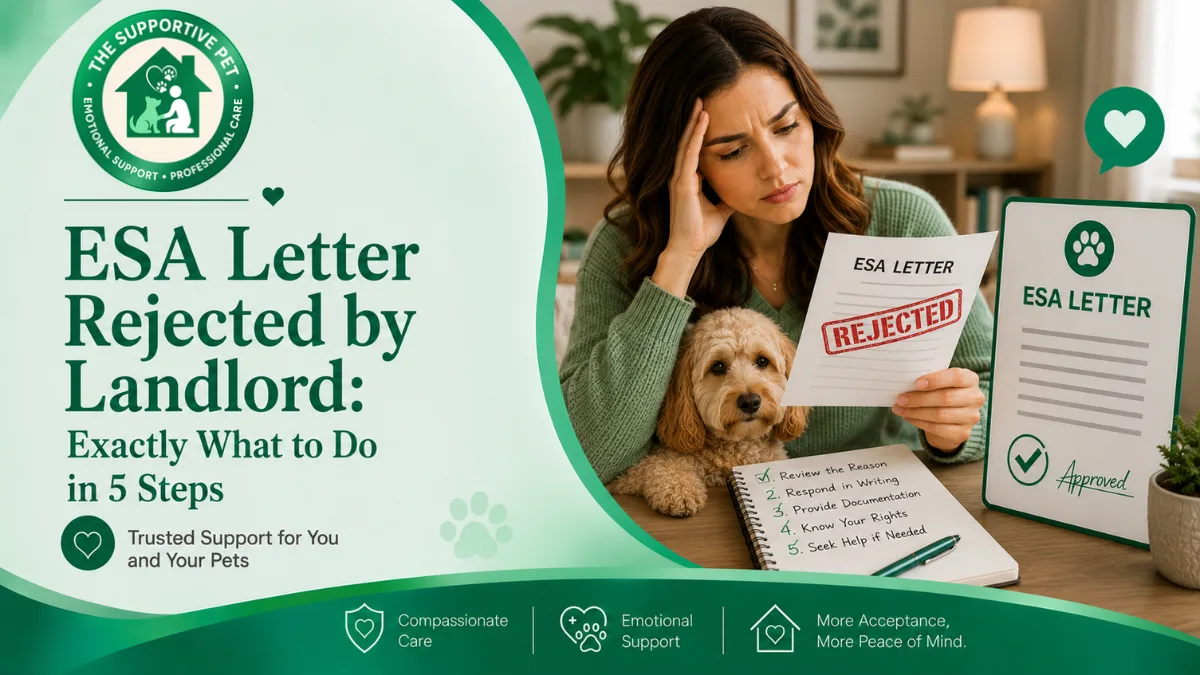
What can I do if my landlord rejects my ESA letter?
If your landlord rejects a properly documented ESA accommodation request, your options include: (1) responding in writing with the FHA citation and HUD guidance; (2) contacting your state's fair housing enforcement agency; (3) filing a complaint with HUD at hud.gov; and (4) consulting a fair housing attorney. Landlords who deny valid ESA accommodation requests are violating the FHA and can face significant penalties.
Key Takeaways
- If a landlord rejects your ESA letter, request the specific reason in writing - common grounds include outdated letters, unverifiable providers, or questions about the nexus.
- An unjustified ESA denial may violate the Fair Housing Act; file a HUD complaint within one year of the denial at hud.gov/program_offices/fair_housing_equal_opp.
- Before escalating, try providing updated documentation or clarifying your provider's credentials - many denials resolve before a formal complaint is needed.
Medical Disclaimer: This article is for informational purposes only and does not constitute medical or legal advice. Consult a qualified mental health professional before making decisions about your care. If you or someone you know is in crisis, call or text 988 (Suicide & Crisis Lifeline, available 24/7).
If your landlord has rejected your ESA accommodation request, you have concrete legal recourse under the Fair Housing Act. Most ESA rejections fall into one of two categories: the landlord doesn't understand the law, or they are hoping you'll give up. In either case, knowing the exact steps to take - and taking them in the right order - gives you the best chance of resolving the situation quickly and keeping your ESA in your home.
Step 1: Get the Denial in Writing
If your landlord verbally denies your ESA accommodation request, immediately request the denial in writing. Send an email or letter asking them to state in writing the reason for their denial. This documentation is critical for any subsequent action - a HUD complaint, state agency complaint, or lawsuit.
Your written request should be simple:
"Thank you for your response to my ESA accommodation request. I would appreciate receiving your decision and the stated reason for denial in writing, via email or letter, so I can review my options. Please send this to [your email/address]."
Step 2: Evaluate Whether the Denial Has a Legal Basis
Landlords can legally deny an ESA accommodation only in specific circumstances:
- The specific animal poses a direct, documented threat to health or safety
- The accommodation would fundamentally alter the housing or impose an undue burden (rare)
- The housing is not covered by the FHA (owner-occupied properties with 4 or fewer units)
- The documentation submitted is not from a licensed mental health professional
If the denial is based on breed, species, general no-pet policy, "other residents don't like animals," or any other reason not in this list, it is likely an FHA violation.
Step 3: Respond in Writing Citing the FHA
Send a formal written response to your landlord citing the legal authority for your request. Keep it factual and non-confrontational:
"I am writing to follow up on my ESA accommodation request, which you have denied. Under the Fair Housing Act (42 U.S.C. § 3604) and HUD's January 2020 guidance on assistance animals, housing providers are required to grant reasonable accommodations for documented emotional support animals, regardless of no-pet policies or breed restrictions. I have provided documentation from a licensed mental health professional confirming my disability and the therapeutic nexus with my ESA. I respectfully request that you reconsider your decision. If I do not hear from you within 10 business days, I will be pursuing my options through HUD's fair housing complaint process."
Step 4: File a HUD Complaint
If your landlord does not respond to your written response or maintains their denial, file a complaint with the Department of Housing and Urban Development. Filing is:
- Free - there is no cost to file a HUD complaint
- Online - at hud.gov/program_offices/fair_housing_equal_opp/online-complaint
- Investigated - HUD assigns an investigator and the landlord must respond to the investigation
- Time-limited - you must file within one year of the discriminatory act
You can also file with your state's fair housing enforcement agency, which may be faster and have additional enforcement tools.
Step 5: Consult a Fair Housing Attorney
Fair housing attorneys handle FHA cases, often on contingency (no upfront fee - they take a percentage of any recovery). You can find fair housing attorneys through:
- The National Fair Housing Alliance (nationalfairhousing.org)
- Your state bar's referral service
- Local legal aid organizations (for lower-income tenants)
Even if you are pursuing a HUD complaint, consulting an attorney helps you understand your options and the strength of your case. A private lawsuit can run parallel to a HUD complaint.
Interim Housing: Protecting Yourself During a Dispute
While your complaint is pending, you may need to make a difficult decision about your housing. Options include:
- Remaining in your current housing while the dispute is resolved (if you have not been evicted)
- Seeking interim housing that accepts your ESA while the complaint proceeds
- Requesting a temporary injunction from a court if eviction is imminent
Do not vacate your housing under pressure if you have a pending FHA complaint - leaving can complicate your remedies. Consult an attorney before making housing decisions during an active dispute.
From the Clinician
ESA rejection cases that reach me are often more about documentation quality than landlord bad faith. An under-specified letter - "this patient has a mental health condition and benefits from their animal" - gives a landlord who wants to push back the opening to do so. HUD's online complaint process is genuinely available and genuinely used, but in my experience, most rejections that reach the complaint stage could have been prevented by stronger initial documentation. I tell clients who come to us after a rejection: the complaint process is a last resort, not a first step. Strong letters, clearly submitted as formal reasonable accommodation requests under the FHA, reach acceptance far more often than complaints that begin with ambiguous or weak documentation.
Client scenario: A client received a written denial from their landlord citing "no documentation from a doctor." Their ESA letter had been issued by an LCSW - a licensed mental health professional fully authorized to issue ESA letters - but the landlord's property manager apparently didn't recognize the credential. After I provided the client with a supplemental letter explaining the LCSW credential, its state licensure requirements, and the HUD provision confirming that ESA letters from licensed mental health professionals are valid, the property manager rescinded the denial without any complaint being filed.
A Fair Look at the Other Side
Landlords who deny ESA letters aren't always acting in bad faith. Many property managers are not lawyers and genuinely don't know what documentation is required or what credentials are valid. Some have been burned by fraudulent letters and are now over-cautious. Approaching a rejection with context - here's what my clinician's credential means, here's the HUD provision that governs this - frequently resolves the situation faster than immediately escalating to a complaint. The complaint process exists for when good faith engagement fails, not as an opening move.
Related: Landlord denied your ESA guide · What a landlord can ask · ESA housing rights
Timelines and What to Expect at Each Stage
HUD Complaint: Typical Timeline
After filing a HUD complaint online at hud.gov/fairhousing, HUD has 100 days to investigate and determine whether there is reasonable cause to believe discrimination occurred. In practice, HUD will first attempt mediation - a voluntary process where a HUD mediator facilitates a resolution between you and your landlord. Many ESA disputes resolve at this mediation stage because landlords recognize the strength of the FHA framework once HUD is involved. If mediation fails, HUD proceeds with a formal investigation. The entire process from complaint filing to resolution averages 6-12 months for contested cases, but mediated resolutions can happen within 60-90 days.
State Fair Housing Agency: Often Faster
Many states have fair housing enforcement agencies that process complaints faster than HUD. Filing with your state agency simultaneously with HUD is generally recommended - whichever agency resolves the case first closes the other. California's DFEH, New York's DHR, and Florida's Commission on Human Relations typically resolve cases in 3-9 months. Texas, Georgia, and most other states have workforce commission civil rights divisions that handle fair housing complaints.
Protecting Yourself During the Dispute
While a fair housing complaint is pending, your landlord cannot retaliate against you for filing - retaliation is itself an FHA violation. Keep copies of all communications. Do not remove your ESA during the dispute period unless you are at immediate risk of eviction. If eviction proceedings begin, consult a fair housing attorney immediately - eviction for exercising ESA rights is a serious FHA violation that courts take seriously. Legal aid organizations in most cities provide free or reduced-cost fair housing representation to low-income renters.
Frequently Asked Questions
What can I do if my landlord rejects my ESA letter?
If your landlord rejects a properly documented ESA accommodation request, your options include: (1) responding in writing with the FHA citation and HUD guidance; (2) contacting your state's fair housing enforcement agency; (3) filing a complaint with HUD at hud.gov; and (4) consulting a fair housing attorney. Landlords who deny valid ESA accommodation requests are violating the FHA and can face significant penalties.
Can a landlord legally reject an ESA letter?
Landlords can deny an ESA accommodation request in limited circumstances: if the specific animal poses a direct threat to the health or safety of others that cannot be mitigated; if the accommodation would cause an undue financial or administrative burden; if the housing is not covered by the FHA (fewer than 4 units where the owner also lives); or if the ESA documentation is not from a licensed professional. They cannot deny based on breed, species, no-pet policy, or preference alone.
How long does a HUD complaint take?
HUD is required to complete its investigation of a fair housing complaint within 100 days of filing. In practice, many cases are resolved through conciliation (negotiated agreement) before that deadline. HUD will first assign an investigator who will attempt to facilitate a resolution. If conciliation fails, HUD issues a charge of discrimination which can proceed to administrative hearing or federal court.
Can I sue my landlord for denying my ESA?
Yes. You can file a private lawsuit in federal court for FHA violations within two years of the discriminatory act. Successful plaintiffs can recover actual damages, emotional distress damages, punitive damages, and attorney's fees. Many fair housing attorneys take these cases on contingency - meaning you pay nothing unless you win. Filing a HUD complaint first is not required to file a private lawsuit.
See our articles highlighted in Google Search
Add The Supportive Pet as a preferred source - your results, your way.