
Does it matter which generation Labradoodle I have (F1, F1B, F2)?
No. ESA letter protections apply to any Labradoodle regardless of generation, coat type, or registration status. Your housing rights are determined by your mental health documentation, not your dog's breeding history.
Medical Disclaimer: This article is for informational purposes only and does not constitute medical or legal advice. Consult a qualified mental health professional before making decisions about your care. If you or someone you know is in crisis, call or text 988 (Suicide & Crisis Lifeline, available 24/7).
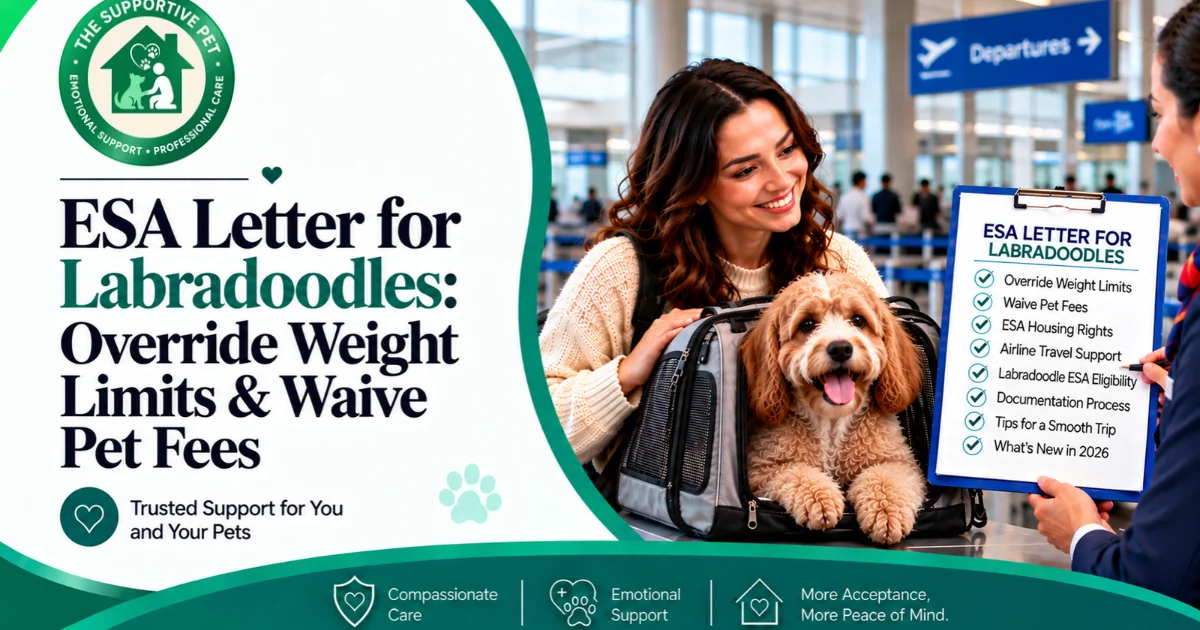
Labradoodles - a cross between Labrador Retrievers and Poodles - combine two of the most clinically validated therapeutic dog breeds. Labs are among the top breeds in animal-assisted therapy programs; Poodles are known for exceptional emotional intelligence. Together, they produce a dog with outstanding therapeutic qualities and a low-shedding coat that expands access for allergy-sensitive owners. Under the Fair Housing Act (42 U.S.C. § 3604), a valid ESA letter eliminates weight limits and waives all pet fees.
Labradoodles as Emotional Support Animals
Standard Labradoodles typically weigh 50–65 lbs; medium Labradoodles 30–45 lbs; miniatures 15–25 lbs. All sizes bring the same core therapeutic traits:
- Emotional attunement - Poodle intelligence means Labradoodles read subtle emotional cues and respond appropriately
- Physical affection - Labs are natural contact-seekers; Labradoodles inherit this trait and provide consistent physical grounding
- Low shedding - hypoallergenic coat reduces barriers to keeping a dog in housing, and reduces household stressors for owners with sensory sensitivities
- Trainability - highly responsive to routine, making them effective for owners who need structure and predictability
Labradoodles are particularly effective for owners managing anxiety, depression, ADHD, and autism spectrum disorder.
What Your ESA Letter Guarantees Under the FHA
With a valid ESA letter:
- Weight limits are waived for your Labradoodle regardless of size
- No pet deposits (refundable or non-refundable)
- No monthly pet rent
- No-pets clauses do not apply
The Fair Housing Act covers virtually all rental housing - apartments, condos, HOA communities, and subsidized housing. See our guide to ESA letters for housing for complete coverage details.
How to Get Your Labradoodle ESA Letter
Your evaluation is about your mental health - not your Labradoodle. A licensed clinician will assess your qualifying condition and issue an ESA letter. The Supportive Pet provides same-day telehealth letters. Start your evaluation here.
Common Qualifying Conditions for Labradoodle ESA Owners
Labradoodles are well-matched to a wide range of qualifying conditions. The following mental health conditions frequently benefit from the specific therapeutic qualities Labradoodles bring:
- Generalized anxiety disorder - their calm responsiveness and steady presence reduce baseline anxiety levels and interrupt worry cycles
- Major depressive disorder - their daily exercise requirements and social engagement needs create motivational structure that counteracts depressive withdrawal
- PTSD and trauma disorders - their sensitivity to emotional state changes allows them to respond before full hyperarousal, and their physical presence reduces the nighttime hypervigilance burden
- ADHD - their trainability and routine needs provide external structure and engagement that benefits focus and reduces impulsivity
- Autism spectrum disorder - their low-shedding coat and gentle temperament make them one of the most recommended breeds for sensory-sensitive autistic individuals
Labradoodle Sizes and Weight Limit Implications
Many apartment complexes set weight limits between 25 and 35 lbs. Even miniature Labradoodles (15-25 lbs) can approach or exceed these thresholds. Standard Labradoodles (50-65 lbs) exceed virtually every apartment weight policy. Without an ESA letter, Labradoodle owners in no-pets or weight-restricted housing face significant barriers.
Under the Fair Housing Act, your valid ESA letter eliminates these barriers entirely. The accommodation applies regardless of your Labradoodle's size or weight - the law does not distinguish between a 20 lb mini Labradoodle and a 65 lb standard. Both receive identical protection.
Making Your Accommodation Request
Once you have your ESA letter, follow this process to submit your accommodation request:
- Write a formal accommodation request - addressed to your landlord or property manager, stating your disability-related need for an emotional support animal and attaching your ESA letter
- Send by documented method - email (with read receipt) or certified mail creates a paper trail; in-person hand delivery without documentation is riskier
- Give a reasonable response window - allow 10-14 business days; your landlord has a right to review and respond
- Follow up in writing if you don't receive a response after two weeks
Your landlord may request reasonable supporting documentation. They may not demand your specific diagnosis, require special ESA certification, or charge an administrative fee for reviewing your request. See our complete ESA letter for housing guide for a full accommodation request template and FAQ.
Frequently Asked Questions: Labradoodle ESA Letters
Q: Does my landlord's insurance override my FHA rights?
No. Insurance-based restrictions cannot override federal fair housing rights. If your landlord's insurance excludes Labradoodles or large dogs, that is their insurance problem - not a legal basis for denying your ESA accommodation.
Q: Can my landlord require my Labradoodle to meet a temperament test?
A landlord cannot require your ESA to pass a temperament test as a universal condition of accommodation. They may only act on documented evidence of a specific, actual threat from your specific animal.
Q: Does my ESA letter expire?
ESA letters do not have a universal expiration date, but most landlords and housing providers expect letters dated within the past year. Many clinicians recommend renewing annually. See our ESA letter renewal guide.
Q: I live in an HOA community - does the FHA still apply?
Yes. HOA communities are covered by the Fair Housing Act in the same way rental housing is. Your Labradoodle ESA is protected from breed bans and weight limits even in HOA-governed communities.
Frequently Asked Questions About Labradoodle ESA Letters
Does a Labradoodle's hypoallergenic coat matter for housing? From a legal standpoint, no. The FHA applies to all breeds. Landlords cannot approve some breeds and reject others when evaluating ESA accommodation requests - they must consider each request based on your disability-related need, not the specific breed.
Can I use my Labradoodle ESA letter in multiple properties? Yes. Your ESA letter documents your disability-related need and can be submitted to any housing provider. You may need to submit a fresh accommodation request each time you move, but the same letter (if current) can support multiple requests.
What if my current landlord approved the ESA but a future landlord refuses? Each landlord must independently evaluate your accommodation request. A prior approval does not bind a new landlord, but it can support your case. Keep records of all approvals and correspondence.
How is an ESA letter different from a prescription? An ESA letter is clinical documentation that you have a disability and that an emotional support animal provides disability-related benefit. It is not a prescription in the medical sense, but it carries legal weight under federal fair housing law.
Begin your free assessment and get the documentation your Labradoodle needs.
Frequently Asked Questions
Does it matter which generation Labradoodle I have (F1, F1B, F2)?
No. ESA letter protections apply to any Labradoodle regardless of generation, coat type, or registration status. Your housing rights are determined by your mental health documentation, not your dog's breeding history.
My building has a breed restriction against Poodle mixes. Does an ESA letter qualify my pet for an exemption from that?
Yes. Breed-mix restrictions are treated identically to breed restrictions under the Fair Housing Act. A valid ESA letter qualifies you for exemptions from any breed or breed-mix restriction in rental housing.
Can I get an ESA letter for my Labradoodle if I already have a pet and pay pet fees?
Yes. If you qualify for an ESA letter, you can submit a reasonable accommodation request and your landlord must retroactively waive ongoing pet fees going forward. You generally cannot recover fees already paid before your accommodation request.
See our articles highlighted in Google Search
Add The Supportive Pet as a preferred source - your results, your way.