
Does a personality disorder qualify for an ESA?
Yes. Personality disorders qualify under the Fair Housing Act (42 U.S.C. § 3604) when they substantially limit major life activities. A licensed mental health professional can assess whether your condition meets this threshold.
Medical Disclaimer: This article is for informational purposes only and does not constitute medical or legal advice. Consult a qualified mental health professional before making decisions about your care. If you or someone you know is in crisis, call or text 988 (Suicide & Crisis Lifeline, available 24/7).
Can a Personality Disorder Qualify for an ESA?
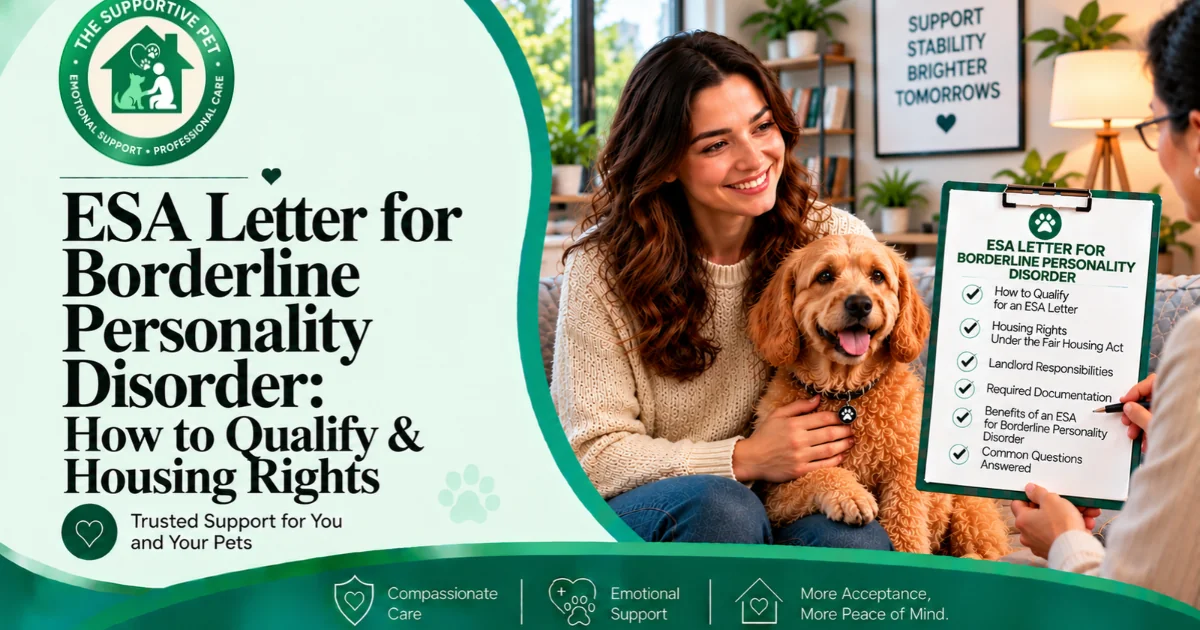
Yes. Personality disorders - including borderline personality disorder (BPD), dependent personality disorder, avoidant personality disorder, and others - can qualify as disabilities under the Fair Housing Act (42 U.S.C. § 3604) when they substantially limit one or more major life activities. The key is not the diagnosis itself but the functional impact. If your personality disorder significantly affects your ability to work, maintain relationships, regulate emotions, manage daily tasks, or participate in social activities, it may meet the disability threshold under the FHA.
A licensed mental health professional who is familiar with your condition and its impact on your daily life is the appropriate person to evaluate whether your situation meets this threshold.
How ESAs Help With Personality Disorders
Emotional support animals provide several forms of therapeutic benefit that can be particularly relevant for personality disorders. For conditions involving emotional dysregulation - like BPD - animals provide a source of consistent, non-judgmental connection. The unconditional nature of the relationship is itself therapeutic: an animal's affection is not contingent on the complex interpersonal dynamics that often make human relationships difficult for people with certain personality disorders.
Caring for an animal also provides routine and external structure. For people whose disorder includes difficulty with self-regulation and impulse control, the responsibility of caring for a pet - with its predictable daily needs - can provide grounding and a sense of mastery. Research on animal-assisted interventions suggests benefits for emotional regulation, loneliness, and mood stability.
Animals also provide physical comfort and grounding in moments of emotional distress. The act of petting a dog or cat activates the parasympathetic nervous system, lowering heart rate and cortisol. For someone in the midst of emotional dysregulation, this physical grounding can interrupt the escalation cycle.
BPD and ESAs - A Closer Look
Borderline personality disorder is characterized by intense emotional instability, fear of abandonment, impulsive behavior, and unstable relationships. All of these features can make housing and daily functioning significantly more difficult. When BPD substantially limits major life activities - which it frequently does - it meets the disability standard under the FHA.
ESAs for BPD often provide their benefit through consistent presence and physical comfort during moments of emotional crisis, through routine and responsibility that support self-regulation, and through unconditional connection that reduces the fear-of-abandonment experiences that characterize the disorder. Many clinicians who work with BPD incorporate ESA recommendations as part of a broader care plan that may include DBT or other evidence-based approaches.
Other Personality Disorders That May Qualify
Avoidant personality disorder involves pervasive social inhibition and hypersensitivity to negative evaluation. When it substantially limits social functioning and occupational performance, it may qualify. Dependent personality disorder, with its excessive need for care and difficulty with separation, can also qualify when functional impairment is significant. Schizotypal and paranoid personality disorders may meet the threshold when cognitive and social functioning are substantially affected.
The common thread is functional impairment. Any personality disorder diagnosis that significantly limits daily functioning can potentially support an ESA accommodation request with appropriate clinical documentation.
Getting the Documentation Right
An ESA letter for a personality disorder must meet the same documentation standards as any other ESA letter. It should come from a licensed mental health professional who has evaluated you, confirm that you have a disability under the FHA (42 U.S.C. § 3604), confirm that your ESA provides disability-related support, and include the provider's credentials and license information on official letterhead.
The provider does not need to name your specific diagnosis or disclose the nature of your personality disorder. The letter confirms the existence of a disability and the therapeutic relationship - not the clinical details. Many providers word letters carefully to protect patient privacy while still meeting documentation requirements.
Using Your ESA Letter for Housing
Once you have your documentation, you can submit a written accommodation request to your landlord or property manager. Under the Fair Housing Act (42 U.S.C. § 3604), covered housing providers must consider such requests in good faith. They may ask clarifying questions and engage in an interactive process, but they cannot demand your full treatment history, require your ESA to be certified or trained, or deny the request without a valid legal reason.
An ESA allows you to request an exemption to no-pet policies, breed restrictions, and weight limits that might otherwise prevent you from living with your animal. It is not a certification of your animal and does not grant public access rights beyond your housing.
Housing Rights With a Personality Disorder ESA
Under the Fair Housing Act (42 U.S.C. § 3604), documented ESA owners can request an exemption from no-pets policies and all pet fees. A landlord evaluating your ESA request does not need to know your specific personality disorder diagnosis - only that you have a disability and that an ESA provides disability-related benefit.
Submitting your request:
- Get your ESA letter from a licensed mental health professional documenting your qualifying condition and therapeutic need
- Write a brief accommodation request to your landlord: state your disability-related need and request accommodation for your ESA
- Attach the ESA letter and send documented
- Allow 10-14 business days for a response
Finding the Right ESA for a Personality Disorder
For people with personality disorders, particularly those involving emotional dysregulation (BPD, ASPD), attachment (dependent personality disorder), or social functioning (avoidant, schizoid), the choice of ESA animal type matters:
- Dogs - provide active, predictable interaction; the structure of daily care can reinforce the routine and responsibility-based coping strategies used in DBT and other evidence-based treatments
- Cats - independent relationship style can be less triggering for people whose personality disorder involves anxious attachment; cats provide presence and comfort without demanding constant engagement
- Lower-maintenance animals - for people whose emotional dysregulation makes consistent pet care challenging during crisis periods, a lower-maintenance animal reduces the risk of guilt and shame cycles that can worsen symptoms
Get Started Today
Begin your ESA evaluation at The Supportive Pet with a licensed clinician who can assess your specific clinical situation.
Maintaining Your ESA Accommodation Over Time
An ESA letter for a personality disorder supports your housing rights for as long as you maintain the qualifying need and the treatment relationship it documents. Legally, the letter does not expire on a fixed schedule, but many landlords and housing providers prefer letters dated within the past 12 months when renewing a lease or establishing a new tenancy. If you work with a mental health provider on an ongoing basis - as is standard for personality disorders - renewal is usually straightforward and requires only an updated letter reflecting your current treatment relationship, not a full re-evaluation from scratch.
Keep copies of every document related to your ESA accommodation: the original letter, any renewal letters, written approval from your landlord, and all related correspondence. If your housing management changes ownership or assigns new staff, present your documentation proactively. The accommodation follows your tenancy rather than the specific personnel who approved it, but proactive disclosure prevents misunderstandings. If you move, present the letter to your new landlord as part of a fresh accommodation request. Building a stable housing history supported by ESA documentation contributes directly to the consistency and predictability that effective personality disorder treatment depends on.
Frequently Asked Questions
Does a personality disorder qualify for an ESA?
Yes. Personality disorders qualify under the Fair Housing Act (42 U.S.C. § 3604) when they substantially limit major life activities. A licensed mental health professional can assess whether your condition meets this threshold.
How does an ESA help with borderline personality disorder?
ESAs provide consistent, non-judgmental connection, physical grounding during emotional dysregulation, and daily routine that supports self-regulation - all of which address core challenges of BPD.
Does my ESA letter need to name my personality disorder?
No. The letter confirms that you have a disability and that your ESA provides disability-related support. Your provider does not need to name your specific diagnosis.
See our articles highlighted in Google Search
Add The Supportive Pet as a preferred source - your results, your way.