
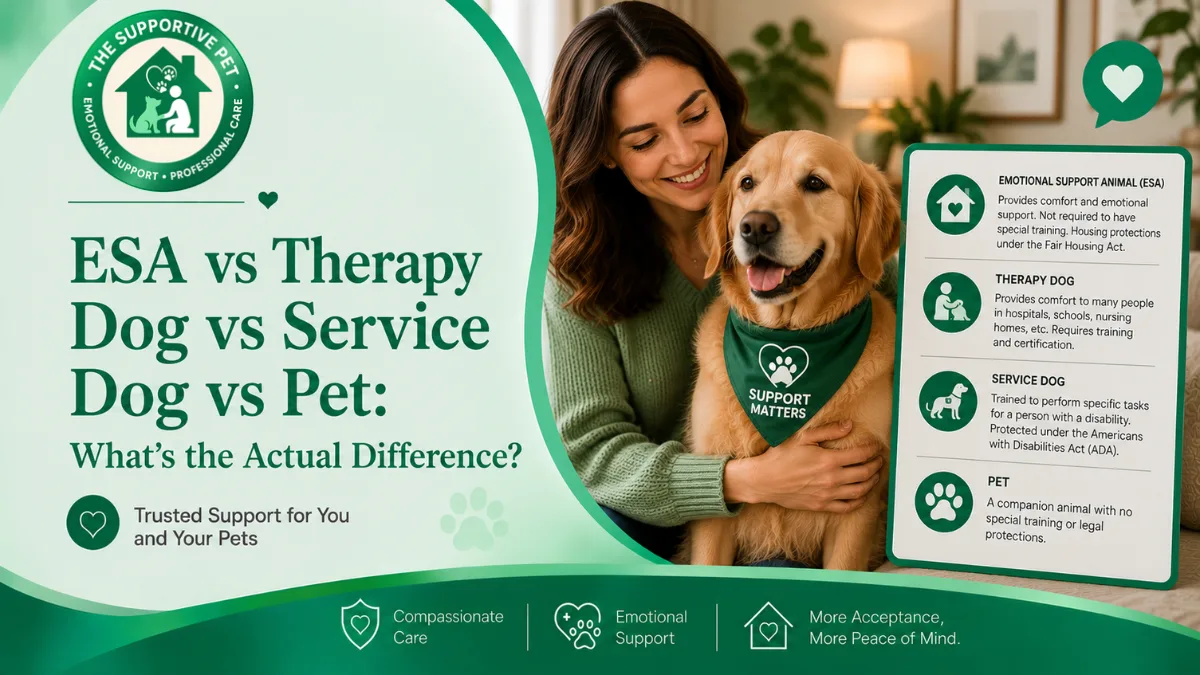
What is the difference between an ESA and a therapy dog?
An ESA is a personally owned animal that provides therapeutic benefit to its individual owner. The owner has FHA housing rights. A therapy dog is a trained dog that visits hospitals, schools, nursing homes, and other facilities to provide comfort to multiple people - not just its owner. Therapy dogs do not have any federal legal rights (no FHA housing rights, no ADA public access rights) - they are admitted to facilities voluntarily, not legally required to be admitted.
Key Takeaways
- ESAs provide housing accommodation under the FHA; therapy dogs visit facilities to support others; service dogs have ADA public access rights - these three roles are legally distinct.
- Only service dogs have the right to enter restaurants, hotels, stores, and other public spaces; therapy dogs and ESAs do not have the same public access protections.
- The right classification matters: an ESA is ideal for housing accommodation; a service dog is for disability mitigation in daily life; a therapy dog is for structured volunteer visits.
Medical Disclaimer: This article is for informational purposes only and does not constitute medical or legal advice. Consult a qualified mental health professional before making decisions about your care. If you or someone you know is in crisis, call or text 988 (Suicide & Crisis Lifeline, available 24/7).
The Four Categories at a Glance
| Category | Legal Basis | Housing Rights | Public Access | Air Travel | Training Required |
|---|---|---|---|---|---|
| Service Dog (physical disability) | ADA, FHA | ✅ FHA | ✅ ADA (full) | ✅ DOT | ✅ Specific tasks |
| Psychiatric Service Dog | ADA, FHA, DOT | ✅ FHA | ✅ ADA (full) | ✅ DOT | ✅ Specific tasks |
| ESA | FHA | ✅ FHA | âÂÅ’ None | âÂÅ’ None | âÂÅ’ None |
| Therapy Dog | None (voluntary) | âÂÅ’ None | âÂÅ’ None (voluntary) | âÂÅ’ None | Training + certification |
| Pet | None | âÂÅ’ None | âÂÅ’ None | Pet policy only | âÂÅ’ None |
Emotional Support Animals (ESAs)
An ESA is any animal that provides therapeutic support for a person's mental health disability through companionship. Key characteristics:
- No training required. The animal does not need to perform tasks or have any specific training.
- Any species. Dogs, cats, rabbits, birds, and other animals can be ESAs.
- FHA housing rights. With a valid letter from a licensed clinician, your ESA gives you the right to request housing accommodation regardless of no-pet policies.
- No public access rights. ESAs cannot accompany you to restaurants, stores, or other public places.
- No airline rights since 2021. ESAs are treated as pets by airlines since the DOT rule change.
An ESA is the right choice when housing protection is your primary need and your animal provides general therapeutic support through its presence and companionship.
Therapy Dogs
A therapy dog is a trained dog (and sometimes its handler team) that visits facilities - hospitals, schools, nursing homes, libraries, disaster relief sites - to provide comfort and interaction to the people there. Key characteristics:
- Benefits many people, not just the owner. Therapy dogs work with multiple recipients, not one specific handler.
- No federal legal rights. Therapy dogs have no rights to access facilities under federal law. Admission is voluntary - facilities invite or allow them.
- Training and certification required. Reputable therapy dog organizations (Pet Partners, Alliance of Therapy Dogs, Love on a Leash) require evaluation and certification before registering a dog-handler team.
- No housing or travel rights. The therapy dog designation gives the owner no ESA or service dog rights whatsoever.
Service Dogs (Including Psychiatric Service Dogs)
A service dog is trained to perform specific tasks that mitigate its handler's disability and has the broadest federal legal protections of any assistance animal category:
- ADA public access. Service dogs can accompany their handler anywhere the public is admitted.
- FHA housing rights. Same as ESAs - housing providers must accommodate.
- DOT airline rights. Service dogs fly in-cabin with their handler at no charge.
- Task training required. The dog must perform at least one specific trained task directly related to the handler's disability.
- Dogs only. Under the ADA, only dogs (and miniature horses in limited circumstances) qualify as service animals.
A Psychiatric Service Dog is a service dog for psychiatric disabilities - PTSD, anxiety, depression, bipolar disorder, and other mental health conditions. The dog must perform a trained task that directly mitigates the disability, but the legal framework is the same as for physical disability service dogs.
Which Do You Need?
- Choose an ESA: You need housing protection; your animal is not a dog or has no task training; your animal provides general therapeutic comfort.
- Choose a Psychiatric Service Dog: You need public access rights; you want in-cabin airline access; your dog performs specific trained tasks for a psychiatric disability.
- Become a therapy dog team: Your dog is well-trained and you want to volunteer in facilities helping others - no personal legal rights involved.
From the Clinician
The confusion between these four categories causes real-world problems - not just conceptual ones. Handlers who claim ADA public access rights with an ESA letter are misrepresenting their animal's legal status. Handlers who don't know their task-trained dog qualifies as a PSD are leaving public access rights and airline accommodations on the table. The ADA's definition of a service animal is the key dividing line: a service animal must be individually trained to perform a task. That threshold is what separates ESAs (presence-based support, no task training required) from PSDs (trained tasks that mitigate a specific psychiatric disability). When I evaluate a client, one of the first things I assess is whether their animal is actually a PSD in functional terms, even if the client thinks of it as an ESA - because the documentation and the legal rights that follow are meaningfully different.
Client scenario: A client came in wanting an ESA letter for their golden retriever, which they described as "helping with anxiety." During the evaluation, they mentioned the dog routinely pressed against them during panic attacks and they had trained the dog to do this on a verbal cue. That's a task - deep pressure therapy - and it made the dog a PSD, not just an ESA. After discussing the distinction, the client chose a PSD letter instead. Six months later, they reported having used the ADA public access rights at their workplace and the DOT documentation for air travel to visit family - rights they would not have had with an ESA letter.
A Fair Look at the Other Side
The three-tier legal system can work against holders who are misclassified - an ESA owner who tries to bring their animal into a restaurant, or a therapy dog owner who assumes they have housing rights, can face real consequences from misunderstanding the distinctions. Venue staff and housing providers also frequently misapply the rules in the opposite direction. Holders routinely face pushback even with correct documentation, which is why understanding not just what your rights are but how to communicate them clearly in a moment of challenge is as important as having the right paperwork.
Related: PSD vs ESA letter · ESA vs service animal · PSD tasks · What is an ESA letter?
Frequently Asked Questions
What is the difference between an ESA and a therapy dog?
An ESA is a personally owned animal that provides therapeutic benefit to its individual owner. The owner has FHA housing rights. A therapy dog is a trained dog that visits hospitals, schools, nursing homes, and other facilities to provide comfort to multiple people - not just its owner. Therapy dogs do not have any federal legal rights (no FHA housing rights, no ADA public access rights) - they are admitted to facilities voluntarily, not legally required to be admitted.
What is the difference between an ESA and a service dog?
A service dog is trained to perform specific tasks that mitigate its handler's disability and has full ADA public access rights. An ESA provides general emotional support without specific task training and has FHA housing rights only. Service dogs can enter any public place the handler can; ESAs cannot. A Psychiatric Service Dog is a type of service dog for psychiatric disabilities - it bridges the gap by requiring task training but addressing mental health conditions.
Which has the most legal rights: ESA, therapy dog, or service dog?
Service dogs (including Psychiatric Service Dogs) have the broadest legal rights - ADA public access, FHA housing, DOT airline access, and more. ESAs have housing rights only under the FHA. Therapy dogs have no legally mandated rights - access is granted voluntarily by facilities. In terms of legal coverage: Service dog > ESA > Therapy dog > Pet.
Can a dog be both a therapy dog and an ESA?
Yes. The same dog can be an ESA for its owner (providing personal therapeutic benefit and granting FHA housing rights) and also be registered as a therapy dog with an organization that visits facilities. The two roles are not mutually exclusive - they involve different functions. The ESA status comes from the owner's relationship and the licensed clinician's letter; the therapy dog status comes from training and registration with a therapy dog organization.
See our articles highlighted in Google Search
Add The Supportive Pet as a preferred source - your results, your way.