
Can I train my own Psychiatric Service Dog?
Yes. The ADA explicitly permits owner-training of service dogs. There is no legal requirement to use a professional trainer or to have your dog certified by any organization. What matters is whether your dog reliably performs a specific task that mitigates your psychiatric disability. Many people successfully owner-train PSDs, though working with a trainer who specializes in psychiatric service dog tasks is strongly recommended for reliability in public settings.
Key Takeaways
- Owner-training a PSD is legal under the ADA and can cost significantly less than purchasing a program-trained service dog, while creating a stronger handler-dog bond through daily work.
- The training process involves public access work, task training, and proof-testing across different environments - typically 1 to 2 years of consistent, documented work.
- A task-trained, well-behaved owner-trained PSD has identical legal rights to a professionally program-trained dog under federal law.
Medical Disclaimer: This article is for informational purposes only and does not constitute medical or legal advice. Consult a qualified mental health professional before making decisions about your care. If you or someone you know is in crisis, call or text 988 (Suicide & Crisis Lifeline, available 24/7).
The Legal Basis for Owner Training
The ADA's implementing regulations (28 CFR § 35.136) define a service animal as "any dog that has been individually trained to do work or perform tasks for the benefit of an individual with a disability." The regulation does not specify who must do the training - professional trainers and owner-trainers are treated identically under the law.
This means you can train your own dog to be a psychiatric service dog, obtain a PSD letter from a licensed clinician documenting your disability and the dog's trained tasks, and - because owner-trained dogs meeting the ADA's individual training standard carry the same legal standing as program dogs - access the full protections of the ADA and FHA, all without spending $15,000-$30,000 or waiting 2-3 years on a placement list.
Foundation Skills Before Task Training
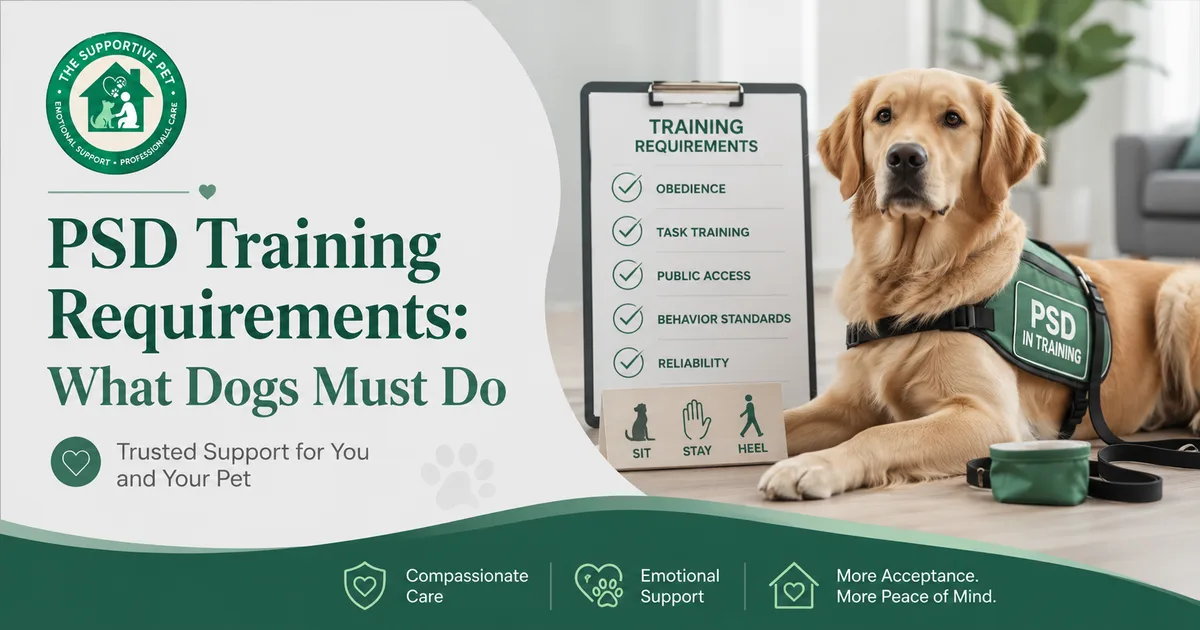
Before teaching psychiatric tasks, your dog needs solid behavioral foundations. A dog with unreliable obedience or poor public behavior will struggle in the high-distraction environments where PSD tasks matter most. Essential foundations include:
- Sit, down, stay, come: Reliable under distraction, not just at home
- Loose-leash walking: Heeling without pulling in busy environments
- Leave it / drop it: Critical for public access safety
- Under (going under a table or chair): For restaurant and indoor public access
- Public access manners: Ignoring food on the floor, not approaching strangers, not reacting to other dogs
If these foundations are not solid, task training will be inconsistent and public access will be difficult. Invest in foundation training before moving to tasks.
Teaching Common Psychiatric Service Dog Tasks
Deep Pressure Therapy (DPT): Start by teaching the dog to put paws up on your lap or against your chest on a verbal cue. Gradually add duration - the dog holds the position until released. Build up to the dog maintaining DPT through your movement and mild distress behaviors. This is typically taught using positive reinforcement with a high-value food reward delivered only when the dog maintains the position.
Tactile Interruption: Teach the dog to nudge or paw at your hand or leg on a verbal cue. Reward immediately and consistently. Then teach the dog to offer this behavior in response to a specific stimulus - a sound, a movement you make when anxious, or at a scheduled time.
Nightmare Interruption: This is one of the more complex tasks to train because it requires the dog to respond during sleep. Teach the dog to respond to specific sounds or movements you make during nightmares (captured from recordings or described to the trainer). The dog needs to be able to wake you using physical contact while you are sleeping - which requires the dog to be confident and persistent about waking a sleeping person.
Room Check: Teach the dog to enter a room on a verbal cue and complete a defined search pattern (typically around the perimeter of the room), then return to a specific position to indicate all-clear. This requires teaching a directional search pattern - usually done with food lures initially, then faded to the cue alone.
Proofing Tasks in Public
A task that only works at home is not a reliable service dog task. "Proofing" means training the dog to perform the task in progressively more distracting environments until the task is reliable everywhere. The progression typically goes:
- Quiet home environment
- Different rooms in the home
- Backyard with minor distractions
- Quiet outdoor spaces (parks, parking lots)
- Pet-friendly stores
- Busy public spaces (malls, markets)
- High-distraction environments similar to where you will need the task performed
Do not rush this progression. A task that is reliable in a quiet park may fall apart in a crowded mall. Take each level until the dog performs with at least 90% reliability before moving to the next.
When to Work With a Professional Trainer
Owner-training is a viable path, but certain situations benefit significantly from professional guidance:
- If your dog has reactivity (barking, lunging) toward other dogs, people, or stimuli - this must be resolved before public access
- If you are struggling to teach a specific task reliably
- If you need tasks that require precise timing and shaping (nightmare interruption, physiological alerts)
- If your own disability makes consistent training difficult
Look for a trainer who specifically works with psychiatric service dog tasks and is familiar with the ADA framework. Certification from organizations like the International Association of Animal Behavior Consultants (IAABC) indicates professional credibility.
Getting Your PSD Letter After Training
Once your dog reliably performs at least one qualifying task, you can apply for a PSD letter from a licensed mental health professional. The evaluation assesses your psychiatric disability and the therapeutic nexus with your dog's specific tasks. At The Supportive Pet, describe the task in behavioral terms when completing your intake - what the dog does, in response to what cue, and how it mitigates your disability. Letters are delivered fast when approved.
From the Clinician
Owner-training is a legal pathway the ADA explicitly permits - there is no federal requirement to use a professional trainer - but I see clients underestimate the documentation burden it creates. When a handler trains their own dog, the burden of demonstrating that the animal is task-trained falls entirely on the clinical letter, because there's no program certificate or professional training log to supplement it. I ask owner-trainers to keep a training log from day one: date, behavior practiced, level of reliability, and any real-world deployment. That log becomes the backbone of a much stronger clinical documentation process when they're ready to apply for a PSD letter.
Client scenario: A client with OCD and a history of contamination-related rituals had spent eighteen months training their Labrador to interrupt compulsive handwashing by nudging them away from the sink and making sustained eye contact - a self-developed protocol they had refined through trial and error. Because they had kept a detailed training log with timestamps and reliability percentages, I was able to cite specific behavioral benchmarks in their PSD letter. Their airline accepted the documentation on first submission without requesting any additional training certification.
A Fair Look at the Other Side
Owner-training works - but it requires honest self-assessment about both the handler's training consistency and the dog's temperament. Many people underestimate the demands of public access work, which requires proofing the dog's behavior across dozens of different environments. A dog that performs tasks reliably at home but struggles in a crowded airport or medical office has not completed service dog training. Working with a professional trainer - even on an owner-train model - significantly increases the likelihood of a reliably behaved, public-access-ready dog.
Related: Full list of qualifying PSD tasks · PSD vs ESA letter · PSD letter cost · ESA vs. PSD Letter comparison · PSD letter for housing
Frequently Asked Questions
Can I train my own Psychiatric Service Dog?
Yes. The ADA explicitly permits owner-training of service dogs. There is no legal requirement to use a professional trainer or to have your dog certified by any organization. What matters is whether your dog reliably performs a specific task that mitigates your psychiatric disability. Many people successfully owner-train PSDs, though working with a trainer who specializes in psychiatric service dog tasks is strongly recommended for reliability in public settings.
What is the difference between owner training and program training for a PSD?
Program training means your dog was trained by a professional service dog organization - often costing $15,000 to $30,000 and involving a wait list of 1–3 years. Owner training means you train the dog yourself, with or without the help of a private trainer. Both are legally valid under the ADA. Owner training is far more accessible financially and allows you to work closely with your own dog from the beginning.
What age should I start training my dog to be a PSD?
Task training typically begins at 6–12 months once the dog has solid obedience fundamentals. Puppies younger than 6 months benefit from socialization and basic obedience work rather than specific task training. Older dogs can also be trained as PSDs - there is no upper age limit, though older dogs learn new tasks more slowly and their career length will be shorter.
Does owner-training a PSD affect the legality of my PSD letter?
No. A PSD letter from a licensed clinician documents your psychiatric disability and the therapeutic nexus with your dog's tasks. It does not matter whether the dog was professionally trained or owner-trained. The letter is equally valid either way. The critical requirement is that the dog reliably performs the task in varied environments.
See our articles highlighted in Google Search
Add The Supportive Pet as a preferred source - your results, your way.