
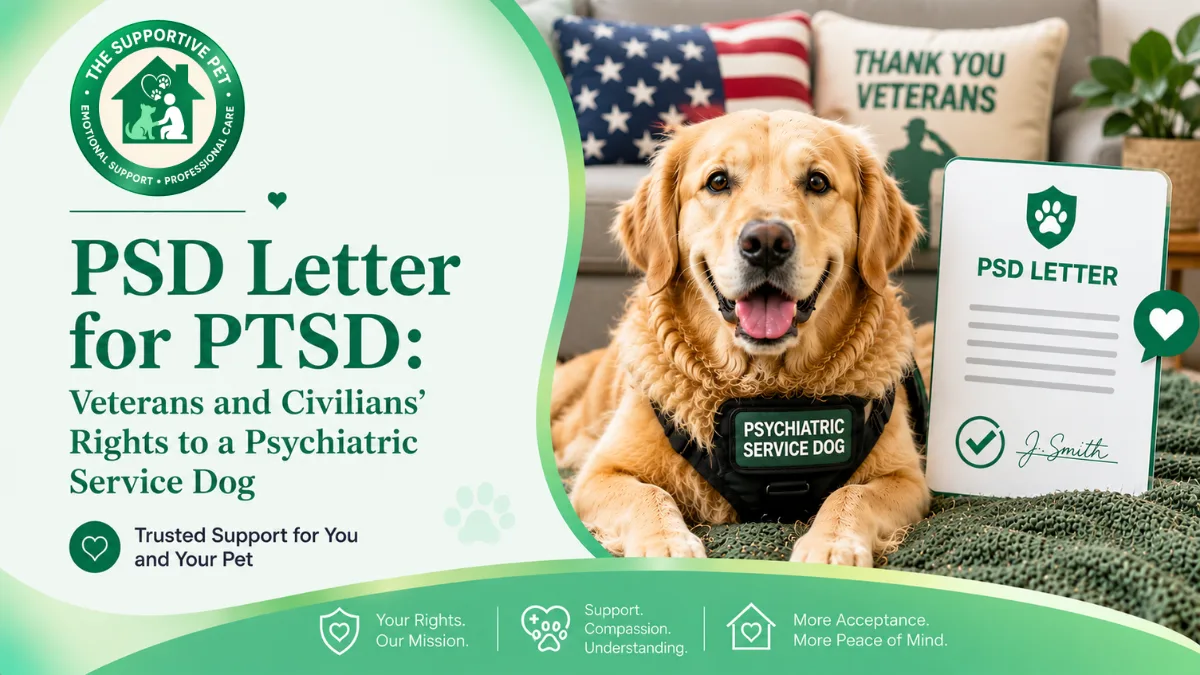
Can PTSD qualify for a Psychiatric Service Dog?
Yes. PTSD is one of the most recognized qualifying conditions for a Psychiatric Service Dog. The ADA recognizes PTSD as a disability, and dogs trained to perform tasks that mitigate PTSD symptoms - such as interrupting nightmares, providing grounding during flashbacks, or creating a physical buffer in crowded spaces - qualify as PSDs. Both veterans and civilians with PTSD from any source can qualify.
Key Takeaways
- A PSD letter for PTSD documents tasks your dog performs to interrupt trauma responses - such as room checks, nightmare interruption, or crowd buffering in public spaces.
- Veterans are among the most common recipients of PTSD service dog documentation; VA records of service-connected PTSD can support but do not replace the clinical evaluation.
- A PSD for PTSD provides both FHA housing rights (like an ESA) and ADA public access rights, making it the broadest legal protection available for veteran and civilian handlers.
Medical Disclaimer: This article is for informational purposes only and does not constitute medical or legal advice. Consult a qualified mental health professional before making decisions about your care. If you or someone you know is in crisis, call or text 988 (Suicide & Crisis Lifeline, available 24/7).
Post-traumatic stress disorder is one of the most established qualifying conditions for psychiatric service dogs - and for good reason. PTSD produces specific, documentable functional limitations that trained dogs can be taught to mitigate with precision. Tasks like interrupting nightmares, preventing startle-response escalations, creating physical buffer space in crowded environments, and performing room-check behaviors are well-defined, trainable, and directly address the disability-related functional impairment. If you have PTSD and a dog trained to help you, a PSD letter provides both housing protections and ADA public access rights.
Why PTSD Is a Strongest PSD Qualifying Condition
Post-traumatic stress disorder is a psychiatric disability that impairs multiple major life activities - sleep, concentration, emotional regulation, social functioning, and often occupational performance. It is among the most clearly documented qualifying conditions for Psychiatric Service Dog status under both the ADA and the FHA.
What makes PTSD particularly well-suited to PSD documentation is the specificity of the tasks available: trained behaviors that directly address PTSD's most disabling symptoms - nightmares, hypervigilance, flashbacks, and hyperarousal - are well-established in the service dog community and have strong clinical rationale.
PTSD Service Dog Tasks: What Counts Under the ADA
A task is a trained behavior that the dog performs reliably in response to a specific cue or trigger, and that directly mitigates the handler's psychiatric disability. For PTSD, the most clinically relevant tasks include:
- Nightmare Interruption: The dog is trained to detect when the handler is in distress during sleep (vocalization, movement, physiological cues) and wake them using a trained tactile cue before the nightmare escalates
- Tactile Grounding: The dog applies physical pressure or makes specific contact to ground the handler during a flashback or dissociative episode
- Deep Pressure Therapy (DPT): Applied during hyperarousal or panic, the dog lies across or against the handler to activate the parasympathetic nervous system
- Room Check (Clearing): The dog is trained to enter a room first and check it before the handler - addressing the hypervigilance that makes entering new spaces distressing
- Cover: The dog positions itself behind the handler in crowds or public spaces, addressing the hypervigilance-driven need to monitor one's back
- Block: The dog positions itself in front of the handler to create a buffer between them and approaching people
- Medication Reminders: The dog is trained to cue the handler to take medication at scheduled times
Veterans and PSD Letters: The Landscape
Veterans with combat-related PTSD make up a significant portion of people seeking PSD documentation. Several important points for veterans:
- The VA does not have a standard PSD letter program. Some VA mental health clinicians will write letters as a courtesy, but this is not a uniform VA service. Many veterans find telehealth ESA/PSD services more consistent and faster.
- A VA disability rating for PTSD supports but does not replace the clinical evaluation. The PSD evaluation still requires a clinician to assess both your disability and your dog's task training.
- Veterans in privatized military housing are typically covered by the FHA. A PSD letter provides both FHA housing rights and ADA public access rights on and off base.
- VA-issued PTSD documentation - C&P exam records, disability rating letters - can be shared with the evaluating clinician to support your case, though it is not required.
PSD Rights for PTSD: Housing and Public Access
A PSD letter for PTSD provides:
- Housing (FHA): Your landlord must allow your PSD regardless of no-pet policies, breed restrictions, or pet deposit rules
- Public Access (ADA): Your PSD can accompany you to any public accommodation - restaurants, stores, theaters, hotels, workplaces - anywhere the public is admitted
- Air Travel (DOT): Your PSD can fly in the airline cabin at no additional charge under DOT service animal regulations
These rights apply only to the tasks your dog performs. Businesses may ask two questions: Is this a service dog required because of a disability? What task has the dog been trained to perform? You are not required to demonstrate the task.
Getting Your PSD Letter for PTSD
At The Supportive Pet, the PSD evaluation covers your PTSD diagnosis, how it affects your functioning, and the specific tasks your dog has been trained to perform. Describe the task in behavioral terms - what the dog does, when it does it, and how it addresses your PTSD symptoms. Letters are delivered the fast when approved.
From the Clinician
Veterans with PTSD represent some of the most well-documented ESA and PSD cases I evaluate. The combination of formal VA documentation - C&P exam records, service-connected disability ratings - and specific, articulable task behaviors in their dogs makes for a strong clinical record. The VA's National Center for PTSD recognizes animal-assisted interventions as a complementary support for veterans - which means the therapeutic evidence base for veteran ESA and PSD requests is well-established. When I evaluate a veteran whose dog has learned to press against them during sleep disturbance, that's not anecdote. That's a documented, consistent behavior with measurable functional outcomes I can put into a letter.
Client scenario: A veteran with combat-related PTSD and a 70% VA rating applied after being rejected from three apartments due to their Belgian Malinois's breed. After I documented the dog's specific room-clearing behavior - entering spaces first and returning to a defined position before the handler entered - as a trained task mitigating PTSD hypervigilance, the veteran applied for a PSD letter rather than an ESA letter. The PSD designation gave them both the housing accommodation and workplace access rights, and their fourth landlord approved within days of receiving the documentation.
A Fair Look at the Other Side
Some mental health professionals caution that relying on a PSD as a primary PTSD coping mechanism can reduce engagement with evidence-based treatments such as EMDR, CPT, or prolonged exposure therapy. PSD documentation works best as part of a comprehensive care plan - the dog addressing specific functional barriers while therapeutic work addresses the underlying trauma. A good PSD evaluation includes a candid conversation about how the animal fits into the broader treatment context, not just whether the task qualifies on paper.
Related guides: ESA letter for PTSD · PSD vs ESA letter comparison · Qualifying PSD tasks · ESA letter for veterans
Getting Your PSD Letter After a Recent PTSD Diagnosis
New Diagnoses and PSD Eligibility
A recent PTSD diagnosis does not disqualify you from getting a PSD letter - in fact, getting proper documentation early can be important for people who are actively managing the condition. What matters is that the diagnosis is genuine, that your dog is trained to perform at least one task that mitigates your PTSD symptoms, and that a licensed clinician can document both the psychiatric disability and the dog's tasks. Licensed mental health professionals who specialize in trauma and PTSD are ideal evaluators for PSD documentation because they understand the functional impact of PTSD in clinical detail.
PTSD PSD Tasks: Documentation Specificity Matters
The most common reason PSD letters for PTSD are challenged is insufficient task documentation. Vague language like "provides emotional support during anxiety" does not describe a trained task - it describes ESA-level behavior. For a PSD letter to hold up, the documented tasks must be specific and trained: "performs deep pressure therapy during panic episodes by placing body weight on handler's lap on command," "alerts handler to approach from behind using physical nudge before person is within three feet," or "performs room check of all rooms in a new environment before handler enters on 'check' command." Work with your evaluating clinician to articulate your dog's tasks at this level of specificity.
Veterans With PTSD: Additional Resources
Veterans with service-connected PTSD have several pathways to PSD documentation and trained dogs. Nonprofit organizations including Paws and Stripes, K9s For Warriors, Warrior Canine Connection, and NEADS provide trained PSDs to veterans at no cost. The VA has a Veterinary Technician Program in some facilities that helps veterans train their own dogs to PSD standards. Veterans who owner-train their dogs can still obtain a PSD letter documenting their PTSD and their dog's trained tasks - the ADA explicitly permits owner-training, and owner-trained PSDs receive the same legal rights as professionally trained ones.
Related: ESA vs. PSD Letter comparison · PSD letter for housing
Frequently Asked Questions
Can PTSD qualify for a Psychiatric Service Dog?
Yes. PTSD is one of the most recognized qualifying conditions for a Psychiatric Service Dog. The ADA recognizes PTSD as a disability, and dogs trained to perform tasks that mitigate PTSD symptoms - such as interrupting nightmares, providing grounding during flashbacks, or creating a physical buffer in crowded spaces - qualify as PSDs. Both veterans and civilians with PTSD from any source can qualify.
What tasks do PTSD service dogs perform?
Common PTSD service dog tasks include: nightmare interruption (waking the handler using a trained tactile cue), tactile grounding during flashbacks or dissociation, deep pressure therapy during hyperarousal or panic, room checks before the handler enters a space (clearing behavior), creating a physical buffer in crowds (blocking or cover), medication reminders, and alerting to escalating hypervigilance before a crisis. The task must be trained and reliable - not simply the comfort of the dog's presence.
Can veterans get a PSD letter for PTSD?
Yes. Veterans with PTSD are among the most common recipients of PSD documentation. The VA does not have a formal PSD letter program, but some VA clinicians will write letters. Most veterans obtain PSD letters through telehealth services like The Supportive Pet. A VA disability rating for PTSD supports the evaluation but is not required.
Does a PTSD service dog need to be professionally trained?
No. The ADA explicitly permits owner-training of service dogs. Many veterans and civilians with PTSD successfully train their dogs to perform specific tasks without professional trainers - though working with a trainer experienced in PTSD-specific service dog tasks is strongly recommended for reliability in public environments.
See our articles highlighted in Google Search
Add The Supportive Pet as a preferred source - your results, your way.