
Can anxiety qualify for a Psychiatric Service Dog?
Yes. Anxiety disorders - including generalized anxiety disorder, panic disorder, and social anxiety disorder - can qualify for a Psychiatric Service Dog when the handler's dog is trained to perform at least one specific task that directly mitigates their anxiety disability. The task must be a trained behavior, not just the general calming presence of the dog. Examples include deep pressure therapy during a panic attack, grounding interruption during dissociation, or alerting to anxiety escalation before a panic attack peaks.
Key Takeaways
- A PSD letter for anxiety documents that your dog is trained to perform specific tasks - like deep pressure therapy or interrupting panic attacks - that directly mitigate your disability.
- Under the ADA, a trained PSD for anxiety may accompany you in workplaces, restaurants, hotels, and other public spaces where ESAs are not permitted.
- The trained-task requirement is the critical distinction: your dog must perform a specific behavior that directly mitigates anxiety, not simply provide general calming presence.
Medical Disclaimer: This article is for informational purposes only and does not constitute medical or legal advice. Consult a qualified mental health professional before making decisions about your care. If you or someone you know is in crisis, call or text 988 (Suicide & Crisis Lifeline, available 24/7).
Anxiety as a Qualifying Disability for PSD Status
A Psychiatric Service Dog (PSD) requires two components: a handler with a qualifying psychiatric disability, and a dog trained to perform at least one specific task that mitigates that disability. Anxiety disorders clearly qualify as psychiatric disabilities under the ADA - they are DSM-5 recognized conditions that substantially limit major life activities.
The question for PSD eligibility is not whether anxiety qualifies - it does - but whether your dog performs a specific trained task that directly addresses your anxiety disability. General companionship and comfort, while therapeutically valuable, do not constitute a trained task for ADA purposes.
Trained Tasks for Anxiety-Related PSDs
The following are examples of trained tasks that can support PSD status for anxiety:
- Deep Pressure Therapy (DPT): The dog applies physical pressure to the handler's body during a panic attack, which activates the parasympathetic nervous system and reduces physiological anxiety response. This must be a trained, reliable behavior - not just a dog that happens to sit on its owner.
- Panic Attack Interruption: The dog is trained to interrupt early signs of a panic attack through tactile contact (nudging, pawing, or licking) to break the anxiety spiral before it peaks.
- Grounding During Dissociation: For anxiety that includes dissociative episodes, the dog is trained to provide tactile grounding cues that reorient the handler to the present.
- Crowd Buffer (Spatial Boundary): For agoraphobia or social anxiety, the dog is trained to position itself in specific ways that create a physical buffer between the handler and crowds.
- Physiological Alert: Some dogs can be trained to alert to early physiological signs of anxiety - increased heart rate, perspiration, or behavioral cues - allowing the handler to implement coping strategies before a full panic attack occurs.
- Medication Retrieval: The dog is trained to retrieve emergency anxiety medication (e.g., benzodiazepines) from a specific location on cue.
PSD Rights vs ESA Rights for Anxiety
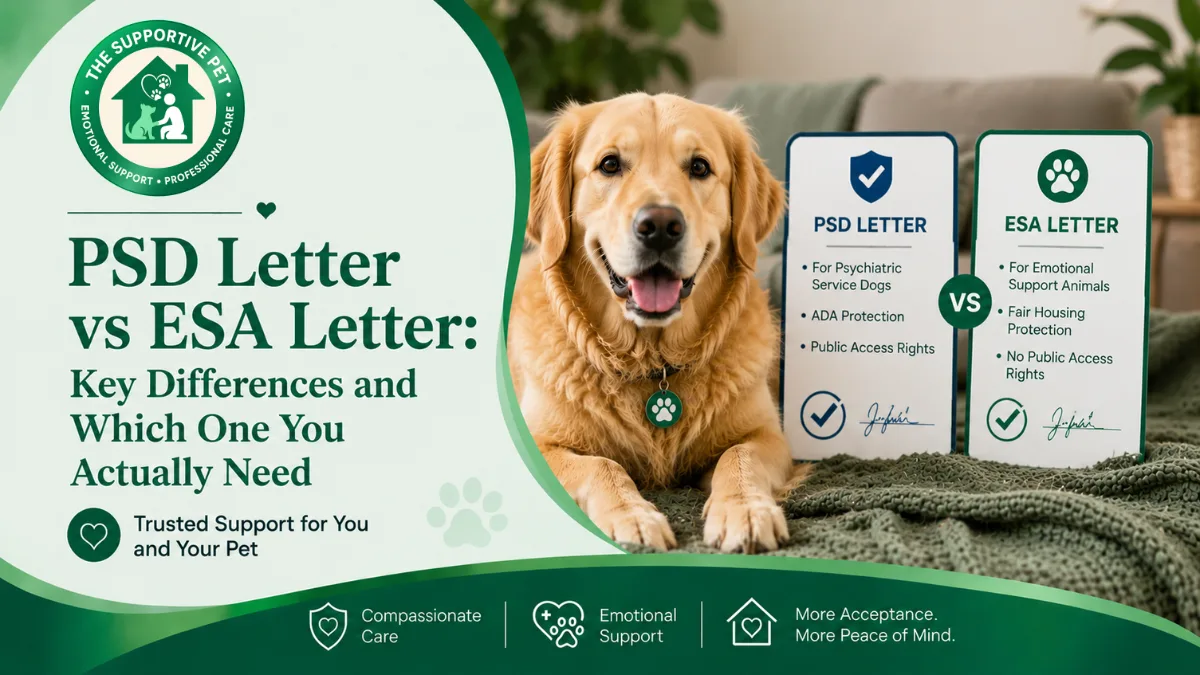
Both a PSD and an ESA provide housing rights under the FHA for people with anxiety. The critical difference is what happens outside the home:
- Your PSD can accompany you to restaurants, grocery stores, movie theaters, hotels, workplaces, and other public accommodations - anywhere the public is admitted
- Your PSD can fly with you in the airline cabin at no additional charge under DOT service animal rules
- Your ESA is legally restricted to housing protections - it does not have the right to enter public places that do not allow pets
For people with panic disorder or agoraphobia whose anxiety is triggered by specific public environments, the public access rights of a PSD can be transformative. Being able to have your dog with you in a grocery store or on a plane - rather than having to navigate those environments without support - directly addresses the disability.
The PSD Evaluation for Anxiety
When applying for a PSD letter through The Supportive Pet, the licensed clinician will assess:
- Your anxiety diagnosis and how it substantially limits major life activities
- The specific task your dog is trained to perform
- Whether the task directly mitigates your anxiety disability
- Whether the task is reliably performed by the dog
Be prepared to describe the task in specific behavioral terms - not "my dog calms me down" but "my dog is trained to lie across my torso when I give the command 'pressure,' which I use at the start of a panic attack." Behavioral specificity strengthens your evaluation and makes your PSD letter more legally defensible.
ESA Letter vs PSD Letter: Which Is Right for Your Anxiety?
Choose an ESA letter if your anxiety primarily affects your housing situation and you do not need public access rights, or if your animal is not a dog, or if your dog has not been task-trained. Choose a PSD letter if you need your dog to accompany you in public spaces, you fly frequently, or your dog performs specific trained tasks that address your anxiety.
From the Clinician
The anxiety-PSD space is where I see the most meaningful clinical outcomes, but also the most evaluation complexity. The ADA's implementing regulations require that a task "directly mitigate" the handler's disability - which for anxiety means the task must address a specific functional limitation, not just general distress. When I ask a client to describe their dog's deep pressure behavior, I'm listening for behavioral specificity: does the dog perform this on a cue, in varied environments, with sufficient duration? A dog that sometimes sits near someone when they're anxious is not the same as a dog that lies across their torso when given the command "pressure" and holds for 5–10 minutes regardless of external distractions. That level of training reliability is what makes the task clinically and legally documentable.
Client scenario: A client with panic disorder and agoraphobia had avoided grocery stores for 18 months. After training their dog to walk beside them in a specific "cover" position that blocked crowding from behind - a task I was able to document in detail - their PSD letter enabled them to bring their dog into a store for the first time. Within three months, they had resumed regular grocery shopping independently.
A Fair Look at the Other Side
Not every anxiety disorder rises to the ADA's disability threshold for public access purposes, and the trained-task requirement exists precisely to distinguish working animals from companion pets. Some animals that genuinely help their owners with anxiety do so through presence and companionship rather than through specific trained behavior - which is legitimate, but describes an ESA rather than a PSD. If your dog does not reliably perform a distinct, disability-mitigating task, an ESA letter for housing is the more appropriate and defensible documentation.
See our full comparison: PSD letter vs ESA letter · ESA letter for anxiety · Full list of qualifying PSD tasks
Related: ESA vs. PSD Letter comparison · PSD letter for housing
PSD vs. ESA for Anxiety: Which Is Right for You?
Understanding the difference between a psychiatric service dog (PSD) and an emotional support animal (ESA) for anxiety is critical because they provide very different levels of legal protection and require different levels of training.
| Feature | Psychiatric Service Dog | Emotional Support Animal |
|---|---|---|
| Legal basis | Americans with Disabilities Act (ADA) | Fair Housing Act (FHA) |
| Public access rights | Full public access (restaurants, stores, flights) | Housing only |
| Housing rights | Full FHA protections (stronger than ESA in some contexts) | Full FHA protections |
| Training required | Specific task training for disability-related needs | None required |
| Species | Dogs only (miniature horses in some situations) | Any domestic animal |
| Documentation | Verbal confirmation of task training (ADA); written letter for housing (FHA) | Written ESA letter from licensed clinician |
Tasks a PSD Can Be Trained to Perform for Anxiety
A dog qualifies as a psychiatric service dog when it is trained to perform a specific task that mitigates a disability. For anxiety disorders, qualifying tasks include:
- Deep pressure therapy (DPT): Lying across the handler's legs or chest during anxiety episodes to provide calming proprioceptive input
- Panic attack interruption: Recognizing pre-panic physiological signals (changed breathing, sweating) and performing a trained alert or interruption behavior
- Anxiety alert: Responding to specific trained cues that the handler is experiencing escalating anxiety and prompting grounding behaviors
- Medication reminders: Trained to alert at scheduled medication times
- Safe room check: Checking rooms before the handler enters, which can reduce hypervigilance in PTSD-related anxiety
- Crowd navigation: Providing a buffer or directed path through crowded spaces for handlers with agoraphobia or social anxiety
- Grounding: Trained to provide tactile stimulation on command to interrupt dissociation or panic spiraling
Getting a PSD Letter for Housing Purposes
While PSDs have ADA public access rights without documentation, housing providers under FHA may still request documentation. For housing purposes, a PSD letter from a licensed mental health professional serves the same function as an ESA letter — it documents your disability-related need for the animal in your housing.
A PSD letter for housing typically includes:
- The clinician's confirmation of your qualifying disability
- A statement that the dog is a psychiatric service dog trained to perform disability-related tasks
- Recommendation for housing accommodation under the FHA
Training Your Dog as a PSD for Anxiety
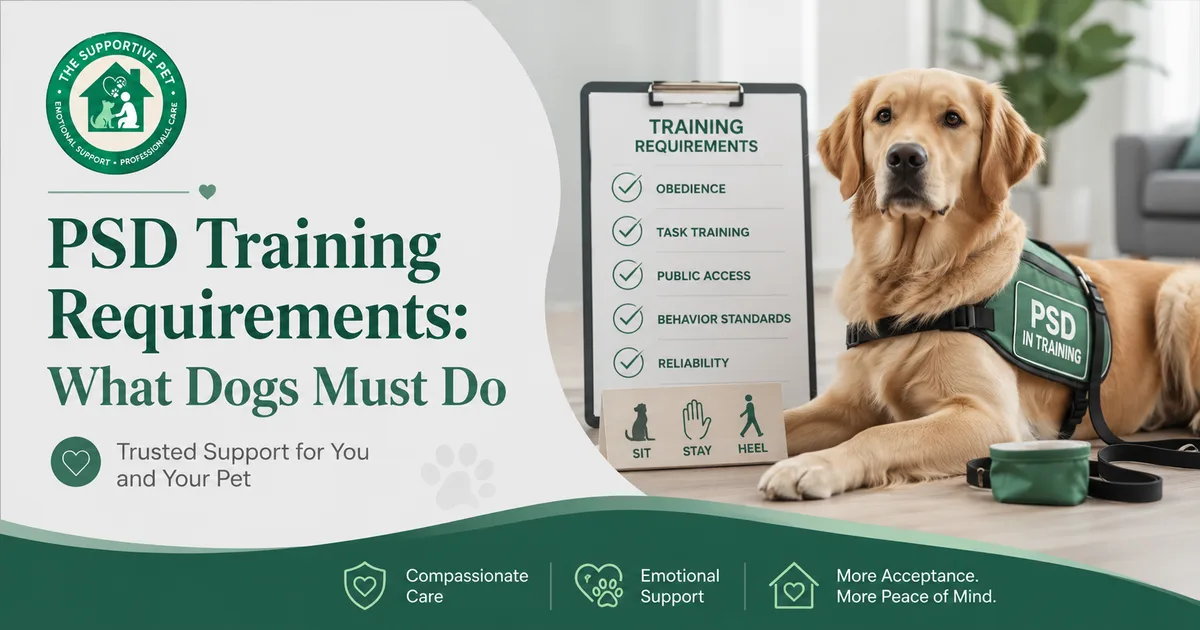
Under the ADA, you can train your own service dog — professional training is not required. However, reliable task training is essential for both effectiveness and practical public access. Options include:
- Professional PSD trainers: Trainers certified in psychiatric service dog training can assess your dog's aptitude and train specific tasks for your anxiety triggers
- Owner-training with a trainer coach: Work with a certified trainer in sessions where you learn to train the tasks yourself — this maintains the owner-dog bond while ensuring task reliability
- Structured online programs: Several organizations offer self-paced PSD owner-training curricula with video evaluation of task performance
Not every dog has the temperament for service work. Dogs being assessed for PSD training should be calm in public settings, not reactive to strangers or other animals, and able to maintain focus on the handler in distracting environments.
Frequently Asked Questions: PSD Letters for Anxiety
Does my dog need to be professionally trained to qualify as a PSD?
No. The ADA allows owner-training of service dogs. What matters is that the dog performs a specific, reliable task that mitigates your disability. Professional training is not required by law, but it is often the most reliable path to consistent task performance.
What if my anxiety is managed and rarely triggered — can I still have a PSD?
Yes. If anxiety substantially limits a major life activity (even with management), you have a qualifying disability. The PSD's task should be relevant to what happens when your anxiety is triggered — even well-managed conditions can have breakthrough episodes that a PSD can address.
Can I convert my existing ESA dog to a PSD?
If your ESA dog can be trained to reliably perform a specific disability-related task, they can function as a PSD. The conversion is about training, not paperwork — once your dog reliably performs a qualifying task, they are functioning as a PSD regardless of their prior ESA status. Update your documentation with a clinician to reflect the PSD designation for housing and other purposes.
Is a PSD letter more protective than an ESA letter for housing?
Both provide FHA housing protection. In practice, housing providers who are familiar with service animals sometimes respond more readily to PSD documentation because it carries the ADA's well-established framework. However, for housing specifically, the protections are equivalent.
Frequently Asked Questions
Can anxiety qualify for a Psychiatric Service Dog?
Yes. Anxiety disorders - including generalized anxiety disorder, panic disorder, and social anxiety disorder - can qualify for a Psychiatric Service Dog when the handler's dog is trained to perform at least one specific task that directly mitigates their anxiety disability. The task must be a trained behavior, not just the general calming presence of the dog. Examples include deep pressure therapy during a panic attack, grounding interruption during dissociation, or alerting to anxiety escalation before a panic attack peaks.
What tasks can a dog perform for anxiety?
Common trained tasks for anxiety include: deep pressure therapy (DPT) - the dog lies on the handler during a panic attack; tactile interruption - the dog nudges or paws at the handler to interrupt anxious behaviors like skin-picking or hair-pulling; alerting - the dog is trained to recognize physiological signs of anxiety escalation and alert the handler; creating personal space - the dog positions itself to create a physical buffer in crowds for those with social anxiety or agoraphobia; and medication retrieval - the dog is trained to retrieve medication from a specific location on cue.
How is a PSD letter different from an ESA letter for anxiety?
An ESA letter for anxiety covers housing rights (FHA) only. A PSD letter covers both housing rights (FHA) and public access rights (ADA) - meaning your dog can accompany you to restaurants, stores, hotels, and other public places. PSDs also retain in-cabin airline access. The requirement for a PSD is that the dog performs specific trained tasks; ESAs require no task training.
Does my dog need professional training to qualify as a PSD for anxiety?
No. The ADA does not require professional training. Owner-trained PSDs are fully legal and recognized. What matters is whether the dog reliably performs a specific task in varied environments, including distracting public settings. Many handlers with anxiety successfully owner-train their dogs with the guidance of a trainer who specializes in service dog tasks.
See our articles highlighted in Google Search
Add The Supportive Pet as a preferred source - your results, your way.