
Is there an official ESA certification?
No. There is no government-recognized ESA certification program in the United States. Emotional support animals are not required to pass any test, complete any training program, or receive any certificate under the Fair Housing Act. The only document that gives an ESA legal housing protection is an ESA letter from a licensed mental health professional.
Medical Disclaimer: This article is for informational purposes only and does not constitute medical or legal advice. Consult a qualified mental health professional before making decisions about your care. If you or someone you know is in crisis, call or text 988 (Suicide & Crisis Lifeline, available 24/7).
What Is ESA Certification? (The Misconception)
If you search "emotional support animal certification" or "ESA certification," you will find pages of websites offering to certify your pet for a fee. The products vary - certificates, pocket ID cards, vests, tags, digital verification QR codes - but they share one characteristic: none of them are issued by any government authority, and none of them carry legal weight under the Fair Housing Act.
The term "ESA certification" was popularized by commercial services that recognized a market opportunity. Many pet owners confuse emotional support animals with service animals, which do have more specific training standards under the ADA (though even service dogs are not "certified" by any federal program). The confusion created demand for a certification product that does not correspond to any actual legal requirement.
ESA Certification vs. Service Dog Certification: The Key Distinction
Even in the service dog world, there is no mandatory federal certification under the ADA. The difference between service animals and emotional support animals matters here, though:
- Service dogs (ADA): Must be trained to perform specific tasks that mitigate a disability. No certification is legally required, but many service dog organizations provide documentation of training.
- Emotional support animals (FHA): Do not require task training. The only requirement is that their owner has a disability and a therapeutic nexus with the animal - established by a clinical letter, not any kind of animal certification.
Because ESAs require no training, the concept of certifying an ESA is even less applicable than certifying a service dog. An ESA is not defined by what it can do - it is defined by the therapeutic relationship it has with its owner. No test or certificate can verify that relationship. Only a clinical evaluation by a licensed professional can.
What Online ESA Certificate Services Are Actually Selling
Private ESA certification websites typically offer:
- A certificate with your pet's photo, name, and a registration number printed on official-looking paper
- An ID card to keep in your wallet or attach to your pet's collar
- A vest for your animal identifying them as a "Certified Emotional Support Animal"
- A verification page or QR code that landlords or others can scan to confirm the "certification"
These are marketing materials, not legal documents. The vest does not grant your animal any rights. The certificate has no legal standing. The verification database is a private website with no regulatory authority. Anyone who purchases these products has purchased confidence and appearance, not legal protection.
What HUD's Guidance Says About Certification Documents
The 2020 HUD Guidance on Assistance Animals is explicit. It states that housing providers "should not" rely on certificates or documents purchased from websites as reliable documentation of disability-related need. Specifically, HUD warns:
"Absent reliable information supporting a disability-related need for a specific accommodation, a housing provider is not required to provide it."
And regarding online documents: "an individual's use of an assistance animal vest, ID card, or online registration does not, by itself, establish that an individual has a disability or a disability-related need for the animal." This is HUD's plain statement that certification products do not satisfy the documentation requirement.
What Landlords and Housing Providers Actually Accept
Under HUD guidance, when a housing provider requests documentation, they are looking for information from a reliable third party - specifically a licensed health care professional - that establishes two things:
- The person has a disability (a physical or mental impairment that substantially limits one or more major life activities)
- There is a disability-related therapeutic nexus - the animal provides benefit related to the person's disability
An ESA certificate establishes neither of these things. A certificate from a website has no connection to a clinical evaluation, no licensed professional's assessment of the person's mental health, and no clinical judgment about the therapeutic relationship between the person and their animal.
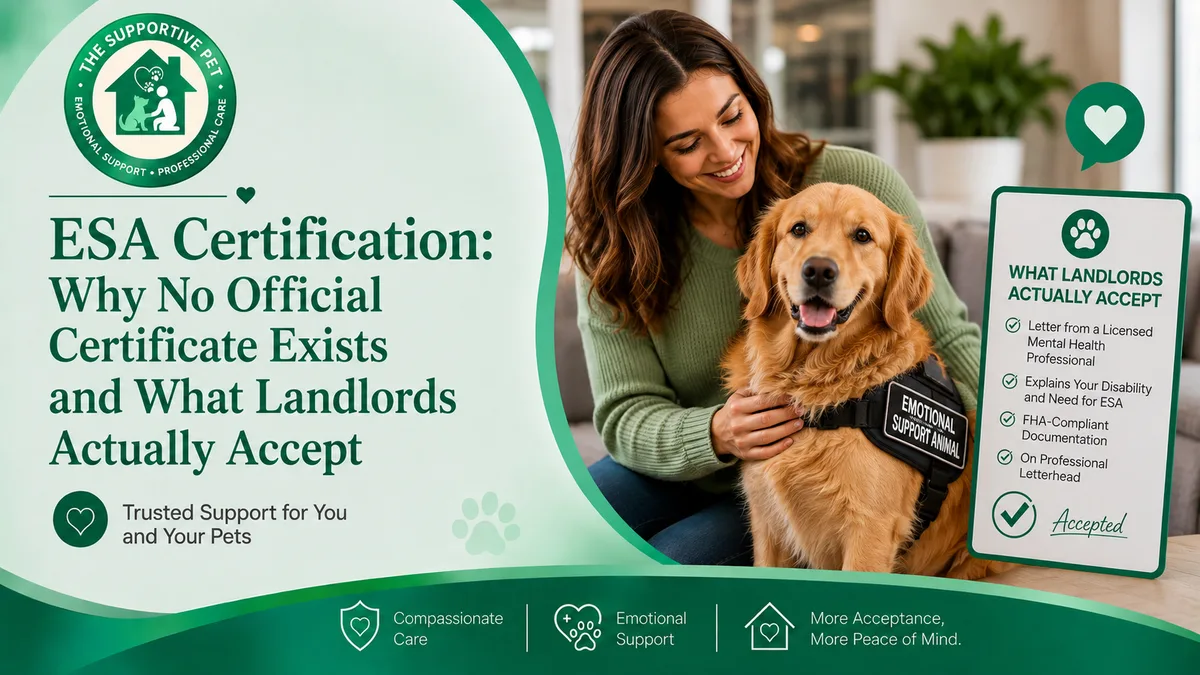
What does establish both things is an ESA letter from a licensed mental health professional (LCSW, LPC, LMFT, psychologist, psychiatrist, or other licensed clinician) who has evaluated your case. The letter can be verified - the clinician's license number can be checked against the state licensing board. The professional can be contacted. The clinical relationship is real.
Does ESA Certification Work for Airlines?
No, and this is worth addressing directly because the airline situation changed in January 2021. The Department of Transportation updated the Air Carrier Access Act rules, allowing airlines to stop recognizing emotional support animals as a separate category. Most major airlines - including Delta, American, United, Southwest, and Spirit - no longer allow ESAs in the cabin regardless of documentation. ESA certificates are no more useful for airlines than for housing.
If you need to fly with your animal, the applicable category is a Psychiatric Service Dog (PSD) - a dog trained to perform specific tasks for a psychiatric disability. PSDs retain in-cabin air travel rights under the DOT rules. See our guide to flying with a psychiatric service dog.
The Only Document That Actually Protects Your Housing Rights
An ESA letter from a licensed mental health professional is the document that activates your Fair Housing Act rights. What that letter needs to contain:
- The name, license type, license number, and state of licensure of the clinician
- A statement that you have a mental health condition or disability
- A statement that the animal provides therapeutic benefit related to your condition
- The date the letter was issued (housing providers typically require letters dated within 12 months)
- The clinician's signature and contact information for verification
The quality of the underlying evaluation matters too. HUD guidance warns housing providers to be skeptical of letters from clinicians who only interact with clients through websites without an in-person or telehealth evaluation, and from "clinicians" who review only questionnaires without any direct clinical assessment. At The Supportive Pet, every letter is issued following a real telehealth evaluation conducted by a licensed professional who reviews your situation directly.
How to Get a Real ESA Letter (Not a Certificate)
If you have a mental health condition that substantially limits your daily functioning, you may qualify for an ESA letter. The process:
- Complete an intake: Describe your mental health condition and how your animal helps you manage it
- Clinical evaluation: A licensed mental health professional reviews your case and conducts a clinical evaluation
- Letter issuance: If you qualify, the clinician issues a letter on their professional letterhead with their license information
- Presentation: You present the letter to your landlord or housing provider
Approval is not guaranteed - clinicians make independent determinations based on your actual clinical situation. That independence is what makes the letter legally reliable.
Related: ESA registration: why it doesn't exist · ESA scam red flags · what is an ESA letter? · online ESA letters vs in-person
Frequently Asked Questions
Is there an official ESA certification?
No. There is no government-recognized ESA certification program in the United States. Emotional support animals are not required to pass any test, complete any training program, or receive any certificate under the Fair Housing Act. The only document that gives an ESA legal housing protection is an ESA letter from a licensed mental health professional.
What is an emotional support animal certification?
ESA "certification" is a term used by private commercial websites to describe a product - typically a certificate, vest, or ID card - they sell for a fee. These products have no legal standing under the Fair Housing Act or any other federal law. They are not issued by any government agency and are not recognized by HUD, housing courts, or fair housing agencies as valid documentation.
Does an emotional support animal need to be certified?
No. The Fair Housing Act explicitly does not require that an emotional support animal be trained, certified, or registered. What the FHA requires is that the person have a disability and that there be a therapeutic nexus between the disability and the animal. That is established by an ESA letter from a licensed mental health professional - not by a certificate.
How do I certify my emotional support animal?
You don't certify an emotional support animal - because no certification process exists under federal law. What you do is obtain an ESA letter from a licensed mental health professional that documents your disability and your therapeutic need for your animal. That letter, not any certificate, is what triggers your housing rights under the Fair Housing Act.
Do ESA certifications work for housing?
No. HUD guidance specifically states that certificates and registration documents sold online are not, by themselves, sufficient documentation for housing accommodation requests. A landlord who receives a certificate from an online service and requests a proper clinical ESA letter instead is acting exactly as HUD directs. Certificates do not protect your housing rights.
See our articles highlighted in Google Search
Add The Supportive Pet as a preferred source - your results, your way.