
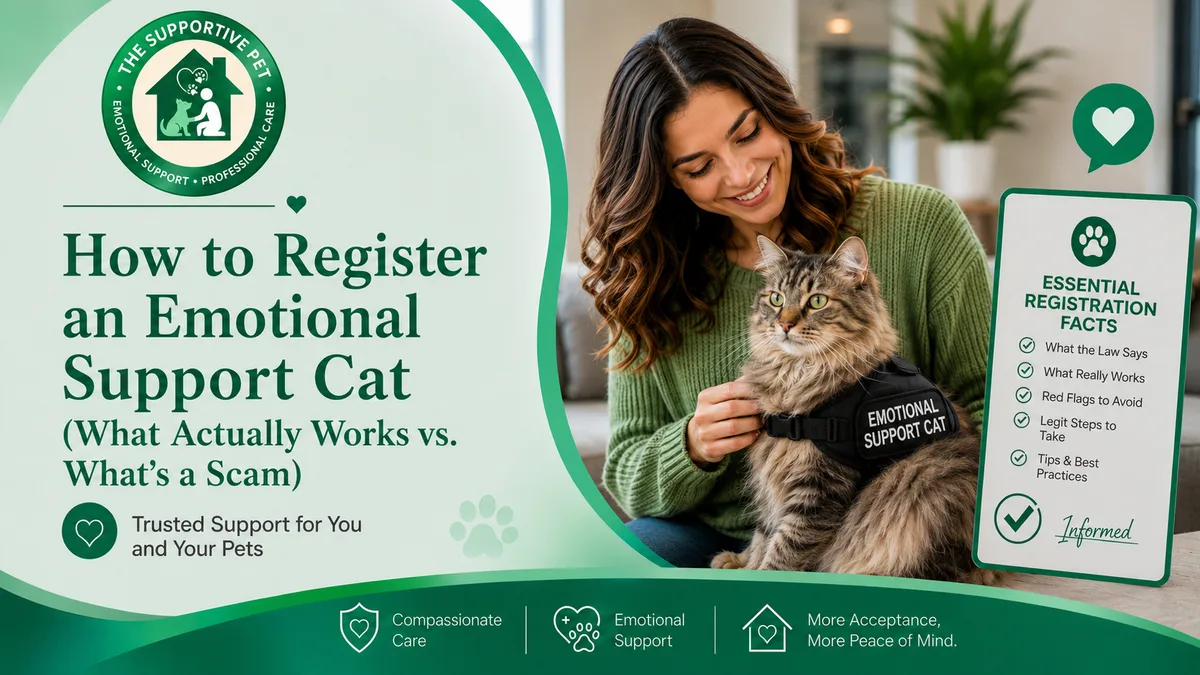
How do I register my cat as an emotional support animal?
Technically, you don't register a cat as an ESA - because no official registration system exists under U.S. law. The process that actually protects your housing rights is getting an ESA letter from a licensed mental health professional who has evaluated your mental health needs. That letter, not any registration certificate, is what triggers your rights under the Fair Housing Act.
Medical Disclaimer: This article is for informational purposes only and does not constitute medical or legal advice. Consult a qualified mental health professional before making decisions about your care. If you or someone you know is in crisis, call or text 988 (Suicide & Crisis Lifeline, available 24/7).
The ESA Cat "Registration" Myth
If you have searched "register emotional support cat" or "emotional support cat registration," you have probably found dozens of websites offering to register your cat for a fee. Before you pay anything, understand what these services are actually selling: a certificate, an ID card, and a database listing that have no legal standing under the Fair Housing Act.
There is no official U.S. government program for registering emotional support animals of any species - including cats. No state, no federal agency, and no recognized authority maintains an ESA registry. The "registration" products sold by private websites are marketing materials designed to look official. They are not.
What Actually Works: The ESA Letter
For your cat to have legal recognition as an emotional support animal for housing purposes, you need an ESA letter - a clinical document issued by a licensed mental health professional who has evaluated your mental health needs and determined that your cat provides therapeutic benefit related to your condition.
This letter is what activates your rights under the Fair Housing Act. When you present a valid ESA letter to your landlord, they must:
- Waive any no-pet policy in your lease
- Waive any breed, size, or weight restrictions
- Not charge pet deposits or pet fees for your cat
- Not limit the number of cats you keep as ESAs (within reason)
An ESA registration certificate does none of these things. Only the letter from a licensed professional triggers these protections.
Cats as ESAs: What the FHA Covers
The Fair Housing Act covers emotional support animals of all types - not just dogs. Cats are specifically recognized as common ESAs. Any cat can be an emotional support cat - there are no breed requirements, age requirements, or training standards. Your cat qualifies as an ESA based on your clinical need, not based on anything specific to the cat.
Common mental health conditions that may qualify for a cat ESA include anxiety disorders, depression, PTSD, panic disorder, ADHD, autism spectrum conditions, and other conditions that cause substantial impairment in daily functioning. Cats provide therapeutic benefit through companionship, routine, and the calming effects of interaction.
Do You Need a Separate ESA Letter for Your Cat?
If you already have an ESA letter for a dog and want to add your cat as a second ESA, or if you have two cats you want recognized as ESAs, you may need an updated or supplemental letter. See our guide on ESA letter for cats and ESA letters for multiple animals for how this works.
How to Get an ESA Letter for Your Cat
- Complete an intake assessment: Describe your mental health condition and how your cat helps you manage it
- Clinical evaluation: A licensed mental health professional reviews your case and evaluates your situation via telehealth
- Letter issuance: If you qualify, you receive a signed letter identifying the clinician's name, license type, license number, and state
- Present to your landlord: Submit your letter as a reasonable accommodation request - your landlord then has a reasonable time to respond
Approval is not guaranteed - the clinician makes an independent determination. But if you have a genuine mental health condition that substantially impacts your daily functioning and your cat provides real therapeutic benefit, you have a strong basis for qualification.
How to Get an ESA Letter for Your Cat: Step by Step
The process of getting an ESA letter for your cat is straightforward when you work with a legitimate provider:
- Complete a clinical intake: Fill out a detailed mental health questionnaire covering your symptoms, diagnosis history, how your condition affects daily functioning, and the therapeutic relationship with your cat. A licensed professional reviews this intake - it is not a checkbox form.
- Clinical evaluation: A licensed mental health professional (LCSW, LPC, psychologist, or psychiatrist) in your state reviews your intake and makes an independent clinical determination about whether you qualify. This takes hours, not seconds - instant automatic approval is a red flag, not a feature.
- Letter issuance: If you qualify, the clinician issues an ESA letter on their professional letterhead. The letter includes their name, license type, license number, and state - all verifiable through the state licensing database.
- Submit to your landlord: Present the letter along with a written reasonable accommodation request. Under the FHA, your landlord must respond within a reasonable time and cannot deny a properly documented ESA request.
What the ESA Evaluation Covers for Cat Owners
A licensed clinician evaluating your ESA request will assess three things:
- Your mental health condition: A DSM-5 recognized condition (anxiety, depression, PTSD, ADHD, bipolar disorder, etc.) that substantially limits a major life activity.
- Functional impairment: How your condition limits daily activities - sleep, work, maintaining stable housing, or managing self-care.
- Therapeutic nexus: The specific ways your cat provides relief related to your condition - companionship during anxiety episodes, motivational structure for depression, sensory grounding, or routine support.
Your cat does not need to be trained, certified, or specially bred. Any cat can be an ESA - the qualifying standard is entirely about your mental health needs, not your cat's characteristics or behavior.
What Your Landlord Can and Cannot Require for a Cat ESA
Once you submit a valid ESA letter for your cat, your landlord:
- Cannot: Charge pet deposits, monthly pet rent, or upfront pet fees
- Cannot: Deny housing based solely on their no-pet policy
- Cannot: Ask for your specific diagnosis or medical records
- Cannot: Require your cat to be trained, registered, or certified
- Can: Verify the clinician holds an active license in your state
- Can: Request clarification if the disability-animal nexus is not clear from the letter
If your landlord wrongfully denies a properly documented ESA accommodation, file a complaint with HUD or your state fair housing agency - the complaint process is free and penalties for non-compliant landlords can be significant.
Related: ESA letter for cats: everything you need to know · ESA registration: why it doesn't exist · what animals can be ESAs
Frequently Asked Questions
How do I register my cat as an emotional support animal?
Technically, you don't register a cat as an ESA - because no official registration system exists under U.S. law. The process that actually protects your housing rights is getting an ESA letter from a licensed mental health professional who has evaluated your mental health needs. That letter, not any registration certificate, is what triggers your rights under the Fair Housing Act.
Can I make my cat an emotional support animal?
Yes - cats are one of the most common emotional support animals. To have your cat recognized as an ESA for housing purposes, you need an ESA letter from a licensed mental health professional documenting that you have a qualifying disability and that your cat provides therapeutic benefit related to that condition. Any breed or size of cat can be an ESA.
Do I need to register my cat as an emotional support animal?
No. There is no legal requirement to register an emotional support cat. ESA registration websites sell certificates and ID cards that have no legal standing under the Fair Housing Act. HUD guidance specifically states that housing providers should not rely on certificates or registration documents from websites as proof of a disability-related need.
How much does it cost to register an emotional support cat?
The "registration" products sold by private websites typically cost $30–$200 and produce documents with no legal value. What you should be paying for is an evaluation by a licensed mental health professional and a proper ESA letter - typically $100–$200 depending on the provider and whether your letter covers one or multiple animals.
Can any cat be an emotional support animal?
Yes. Unlike service animals, emotional support cats do not need any special training, breed requirements, or size qualifications. Your cat is recognized as an ESA based on your clinical need - not the cat's characteristics. Your landlord cannot reject your ESA cat based on breed, size, or any physical characteristic.
See our articles highlighted in Google Search
Add The Supportive Pet as a preferred source - your results, your way.