
Do I need to send a separate accommodation request letter along with my ESA letter?
Yes. Your ESA letter documents your clinical need; the accommodation request letter is the formal legal notice to your landlord asking them to make specific exceptions. Both are needed to trigger the Fair Housing Act process.
Medical Disclaimer: This article is for informational purposes only and does not constitute medical or legal advice. Consult a qualified mental health professional before making decisions about your care. If you or someone you know is in crisis, call or text 988 (Suicide & Crisis Lifeline, available 24/7).
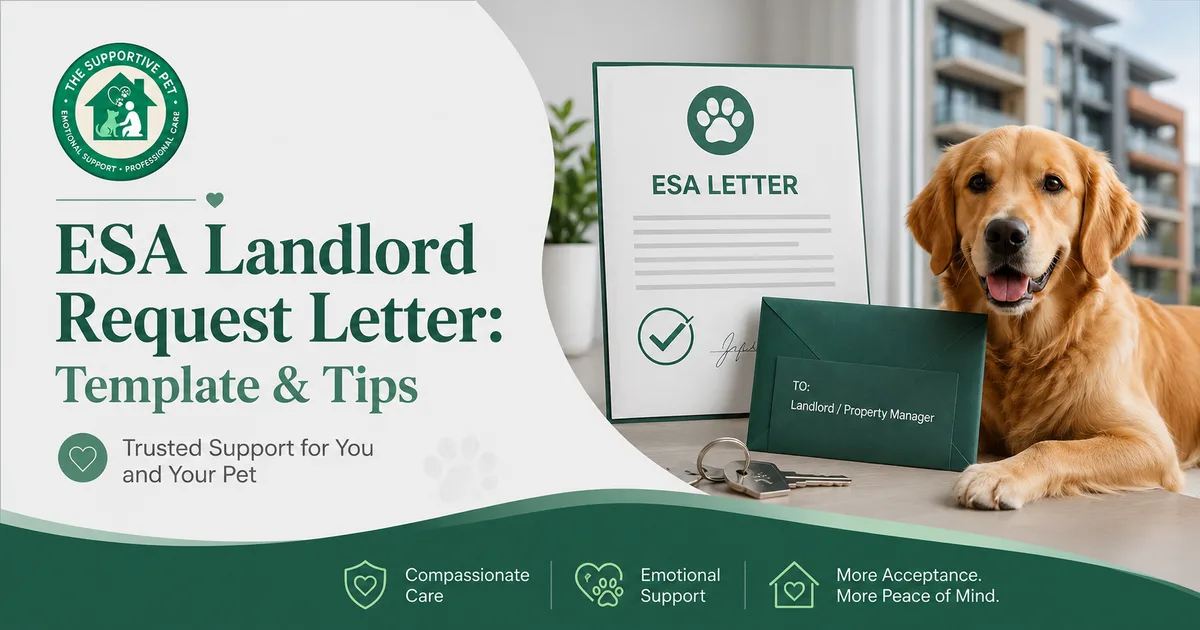
Many ESA owners focus entirely on getting their ESA letter and forget that the letter alone is not enough. To exercise your rights under the Fair Housing Act (42 U.S.C. § 3604), you also need to send a written accommodation request to your landlord. The request triggers the legal process - without it, your landlord has no formal obligation to act. Here is how to write one that works.
What Is an ESA Accommodation Request?
A reasonable accommodation request is a formal written request to your housing provider asking them to make an exception to their standard policies - in this case, their no-pets policy, weight limits, breed restrictions, and pet fees - as an accommodation for your disability. The Fair Housing Act requires housing providers to engage with reasonable accommodation requests in good faith.
Submitting the request in writing is critical because it:
- Creates a dated record of when you made the request
- Starts the clock on the landlord's obligation to respond within a reasonable timeframe
- Provides documentation you can use if you need to file a fair housing complaint
What to Include in Your ESA Accommodation Request Letter
Your accommodation request does not need to be long or formally structured - clarity and completeness matter more than legal language. Include:
- Your full name and unit address
- The date
- Landlord or property manager name and address
- A statement that you have a disability - you do not need to disclose your diagnosis; stating you have a disability-related need is sufficient
- A statement about your ESA - name and species of your animal, and that it is an emotional support animal that provides disability-related benefit
- Your specific accommodation request - permission to keep the animal in your unit, waiver of all pet fees, and an exemption from breed or weight restrictions as applicable
- Reference to the Fair Housing Act - citing 42 U.S.C. § 3604 shows you understand your rights
- An enclosed copy of your ESA letter - attach it to or include it with your request
- Your contact information and a request for a written response
Sample ESA Accommodation Request Letter
Below is a template you can adapt:
[Date]
[Your Name]
[Your Unit Address]
[Landlord/Property Manager Name]
[Property Management Address]
Dear [Landlord Name],
I am writing to request a reasonable accommodation under the Fair Housing Act (42 U.S.C. § 3604). I have a disability that substantially limits one or more major life activities, and I require an emotional support animal as part of my treatment plan.
I am requesting permission to keep my [species - e.g., dog], [animal name], in my unit at [your address]. I am also requesting a waiver of all pet-related fees and deposits, including any non-refundable pet deposit, refundable pet deposit, and monthly pet rent, as a reasonable accommodation for my disability.
I have enclosed a letter from my licensed mental health professional confirming my disability-related need for an emotional support animal. This documentation satisfies HUD's guidance on reasonable documentation for ESA accommodation requests.
Please respond in writing at your earliest convenience, and no later than [10-14 business days from the date above]. I am happy to discuss this request further if needed.
Sincerely,
[Your Name]
[Phone Number]
[Email Address]
How to Send Your Accommodation Request
Send your request using a method that creates a verifiable record:
- Email - request a read receipt; email timestamps serve as documentation
- Certified mail with return receipt - provides proof of delivery
- Both - email for speed, certified mail as backup documentation
Avoid verbal requests alone - if the landlord denies your request later and there is no written record, you have no documentation to support a fair housing complaint.
What You Do Not Need to Include
Common oversharing mistakes to avoid:
- Your specific diagnosis - you are not required to disclose it; stating you have a disability is enough
- Details of your treatment or medications - not required documentation
- Your medical history - far beyond what HUD considers reasonable documentation
- ESA registration, certification, or vests - these have no legal standing and landlords cannot require them
After You Submit the Request
Your landlord must respond within a reasonable timeframe - typically 10-14 business days. If they request additional information, they should do so within that window. Once they receive a valid ESA letter, they have everything HUD guidelines require.
If your landlord denies your request, they must provide written notice of the denial with the reason. That documentation is essential for any follow-up action. See our guide to what to do when a landlord rejects your ESA request.
Getting Your ESA Letter
If you do not yet have an ESA letter to attach to your accommodation request, The Supportive Pet connects you with state-licensed clinicians for same-day telehealth evaluations. Start your evaluation here.
Frequently Asked Questions About ESA Accommodation Requests
Q: Does my accommodation request need to be in a specific legal format?
No. There is no required format under the Fair Housing Act. A clear, written request including the key elements above is sufficient. Overly formal legal language is not necessary.
Q: What if my landlord uses their own ESA form and says I must complete it?
Your landlord may use a standard form, but they cannot require that form to the exclusion of your valid ESA letter. If their form asks for information beyond what HUD considers reasonable (such as your diagnosis), you are not required to provide it.
Q: Can I submit my ESA accommodation request before I have signed a lease?
Yes. If you are applying for a new apartment, you can submit your accommodation request during the application process. See our guide to ESA letters for new apartments.
Related Resources
- How long does a landlord have to respond to an ESA request?
- ESA letter for housing - complete guide
- What can a landlord ask about your ESA?
After You Submit: What to Expect
Once your ESA accommodation request is in your landlord's hands, here is what comes next:
- Acknowledgment - a prompt landlord will acknowledge receipt within a few days. If you hear nothing within 5 days, follow up in writing asking for confirmation.
- Verification request - your landlord may ask for clarification or additional verification that you have a disability and need an ESA. Provide only what is necessary - typically a re-confirmation from your clinician - and nothing more (no diagnosis specifics, no medical records).
- Decision - most straightforward ESA requests are approved within 10-14 business days. Approval should include written confirmation that pet fees and policies are waived for your ESA.
- Denial or unreasonable delay - if your request is denied without a lawful basis, or if the landlord simply ignores it, you can file a complaint with HUD (hud.gov) or your state's civil rights agency.
Keep every piece of correspondence - email threads, any written responses from your landlord, and your original submission. This documentation is essential if you ever need to escalate.
Need your ESA letter first? Get yours through The Supportive Pet.
Frequently Asked Questions
Do I need to send a separate accommodation request letter along with my ESA letter?
Yes. Your ESA letter documents your clinical need; the accommodation request letter is the formal legal notice to your landlord asking them to make specific exceptions. Both are needed to trigger the Fair Housing Act process.
Should I disclose my diagnosis in my accommodation request letter?
No. You are only required to state that you have a disability and that your emotional support animal provides disability-related benefit. Disclosing your specific diagnosis is not required and not recommended.
What should I do if my landlord ignores my accommodation request letter?
Follow up in writing after 10-14 business days. If they continue to ignore it, you can file a complaint with HUD at hud.gov. Document all communications and dates throughout the process.
See our articles highlighted in Google Search
Add The Supportive Pet as a preferred source - your results, your way.