
My apartment has a 35 lb weight limit. Can my 65 lb Goldendoodle be an ESA there?
Yes. The Fair Housing Act exempts you from weight limits for documented ESA owners. Your landlord must waive the weight restriction as a reasonable accommodation once you provide a valid ESA letter from a licensed clinician.
Medical Disclaimer: This article is for informational purposes only and does not constitute medical or legal advice. Consult a qualified mental health professional before making decisions about your care. If you or someone you know is in crisis, call or text 988 (Suicide & Crisis Lifeline, available 24/7).
Goldendoodles have become one of the most requested emotional support animal breeds in the United States. Their combination of the Golden Retriever's therapeutic temperament and the Poodle's low-allergen coat makes them uniquely suitable for emotional support roles - particularly for owners who need a larger dog in housing that prohibits pets or enforces weight limits.
Why Goldendoodle Owners Need an ESA Letter
Standard-size Goldendoodles typically weigh 50–90 lbs, exceeding most apartment weight limits (commonly 25–35 lbs). Mini Goldendoodles (15–35 lbs) still frequently exceed thresholds in stricter buildings. Under the Fair Housing Act (42 U.S.C. § 3604), a valid ESA letter eliminates:
- All weight limit restrictions
- All pet deposits (refundable and non-refundable)
- Monthly pet rent
- No-pets policy enforcement
Goldendoodles as Emotional Support Animals
The Goldendoodle inherits therapeutic traits from both parent breeds. Golden Retrievers are among the most clinically documented breeds for animal-assisted therapy. Poodles contribute high trainability and emotional attunement - Poodles are known for reading human emotional states with unusual accuracy. The combination produces a dog that is:
- Highly attuned to mood shifts
- Consistently gentle and non-reactive
- Well-suited to contact comfort (physical closeness without crowding)
- Low-shedding, making them accessible to owners with allergies
Goldendoodles are particularly effective for owners managing anxiety disorders, depression, PTSD, and social anxiety disorder. Their calm responsiveness and predictable behavior reduces the unpredictability that often exacerbates anxiety symptoms.
Housing Protections Under the Fair Housing Act
The Fair Housing Act requires housing providers to make reasonable accommodations for people with disabilities, including allowing emotional support animals. This applies to virtually all rental housing except owner-occupied buildings with four or fewer units where the owner lives on-site.
Your Goldendoodle ESA letter gives you:
- The right to keep your Goldendoodle regardless of weight limits or no-pets policies
- Full waiver of all pet-related fees
- Protection from eviction based on having an ESA
How to Get Your Goldendoodle ESA Letter
Your evaluation focuses entirely on your mental health - not your Goldendoodle's breed, size, or training. A licensed clinician will assess your qualifying condition and confirm that your Goldendoodle provides therapeutic benefit. The Supportive Pet provides same-day letters through telehealth evaluations with state-licensed mental health professionals. Start your evaluation here.
Goldendoodle Generations and What They Mean for ESA Owners
Goldendoodles are sold in multiple "generations" - F1 (50% Golden Retriever, 50% Poodle), F1B (backcross with Poodle, lower shedding), F2 (second generation), and multigenerational. These distinctions matter primarily for coat type and shedding. For ESA purposes, all generations are equally eligible under the Fair Housing Act. F1B and multigenerational Goldendoodles tend to shed less and are more suitable for owners with allergies - a practical consideration when choosing your ESA, but irrelevant to the ESA qualification itself.
Making Your Accommodation Request Work
Goldendoodles frequently encounter housing resistance due to their size. Standard Goldendoodles (50-90 lbs) trigger both weight limit and sometimes "large dog" restrictions. Here's how to navigate the accommodation process effectively:
- Get a current ESA letter from a licensed clinician via telehealth - the evaluation focuses on your mental health, not your Goldendoodle
- Write a formal accommodation request to your landlord: include your name, address, a statement of disability-related need, and a copy of your ESA letter
- Send documented - email with read receipt or certified mail creates a paper trail
- Be patient but persistent - your landlord has a reasonable review window (typically 10-14 business days)
If you receive a denial citing breed or weight restrictions, respond in writing citing the Fair Housing Act (42 U.S.C. § 3604) and specifying that those restrictions cannot be applied to documented ESA owners. See our guide to challenging breed-based ESA denials.
Frequently Asked Questions: Goldendoodle ESA Letters
Q: My building has a "50 lb maximum" policy. My Goldendoodle weighs 65 lbs. Can my ESA letter still work?
Yes. Weight limits cannot be enforced against a documented ESA owner under the Fair Housing Act. Your valid ESA letter qualifies you to request an exemption from the weight limit policy, and your landlord is required to grant it absent a lawful basis for denial.
Q: Does the type of landlord matter - does the FHA apply to private landlords the same as large property management companies?
The Fair Housing Act applies to virtually all rental housing, including private individual landlords. The main exceptions are owner-occupied buildings with four or fewer units (where the owner lives on-site) and certain religious organizations renting to their own members. Your Goldendoodle ESA is protected in virtually all other rental situations.
Q: Can my Goldendoodle be certified or registered as an ESA?
No ESA certification or registration has legal standing. National "ESA registries" and certification cards sold online are not recognized by HUD or landlords - what matters legally is an ESA letter from a licensed mental health professional. See our guide to avoiding fake ESA letter scams.
Q: I already have a therapist who treats me. Can they write my ESA letter?
Yes. If your existing therapist or mental health provider has treated you and can confirm your qualifying condition and need for an ESA, their letter is fully valid. You do not need a separate evaluation from a new provider.
What to Expect After You Receive Your ESA Letter
Once your Goldendoodle's ESA letter is in hand, here is how to use it effectively.
Submit to your landlord in writing. Provide a copy of the letter along with a written accommodation request. Keep a copy for your records and note the date you submitted it.
Allow reasonable response time. Landlords typically have 10-14 days to respond. If you have not heard back, follow up politely in writing.
Know what landlords can and cannot ask. They may request documentation confirming you have a disability and that the ESA provides disability-related benefit. They cannot ask for your diagnosis, demand medical records, or require a specific form.
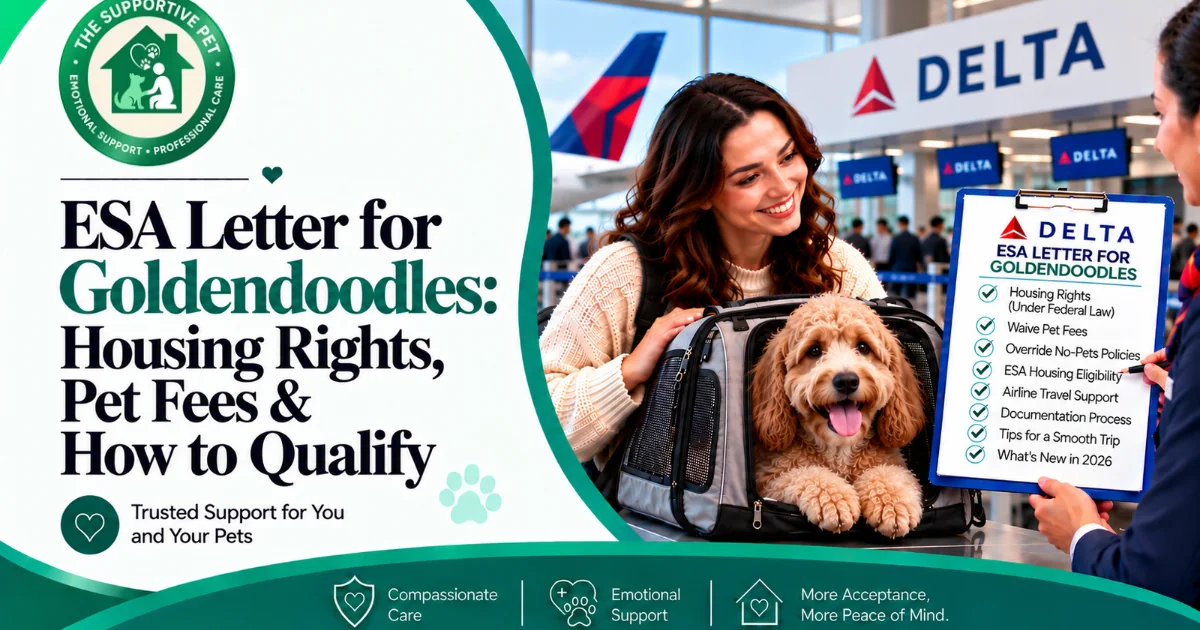
Airline travel is different. Since the 2021 DOT rule change, all major U.S. airlines may treat ESAs as ordinary pets. If you need to fly with your Goldendoodle, check each airline's current pet-in-cabin policy or consider whether a Psychiatric Service Dog (PSD) better fits your travel needs.
Begin your free assessment to see whether your Goldendoodle qualifies as your ESA.
Frequently Asked Questions
My apartment has a 35 lb weight limit. Can my 65 lb Goldendoodle be an ESA there?
Yes. The Fair Housing Act exempts you from weight limits for documented ESA owners. Your landlord must waive the weight restriction as a reasonable accommodation once you provide a valid ESA letter from a licensed clinician.
Will my Goldendoodle's mixed-breed status cause any ESA letter issues?
No. ESA letters have no breed restrictions whatsoever. Any dog of any breed, size, or mix qualifies based entirely on your mental health need - not the dog's characteristics.
Do I need to renew my Goldendoodle ESA letter?
ESA letters are typically valid for one year. Many landlords and housing providers request a current letter at the start of each lease year. The Supportive Pet offers streamlined annual renewals. See our <a href='/esa-letter-renewal'>ESA letter renewal guide</a>.
See our articles highlighted in Google Search
Add The Supportive Pet as a preferred source - your results, your way.