
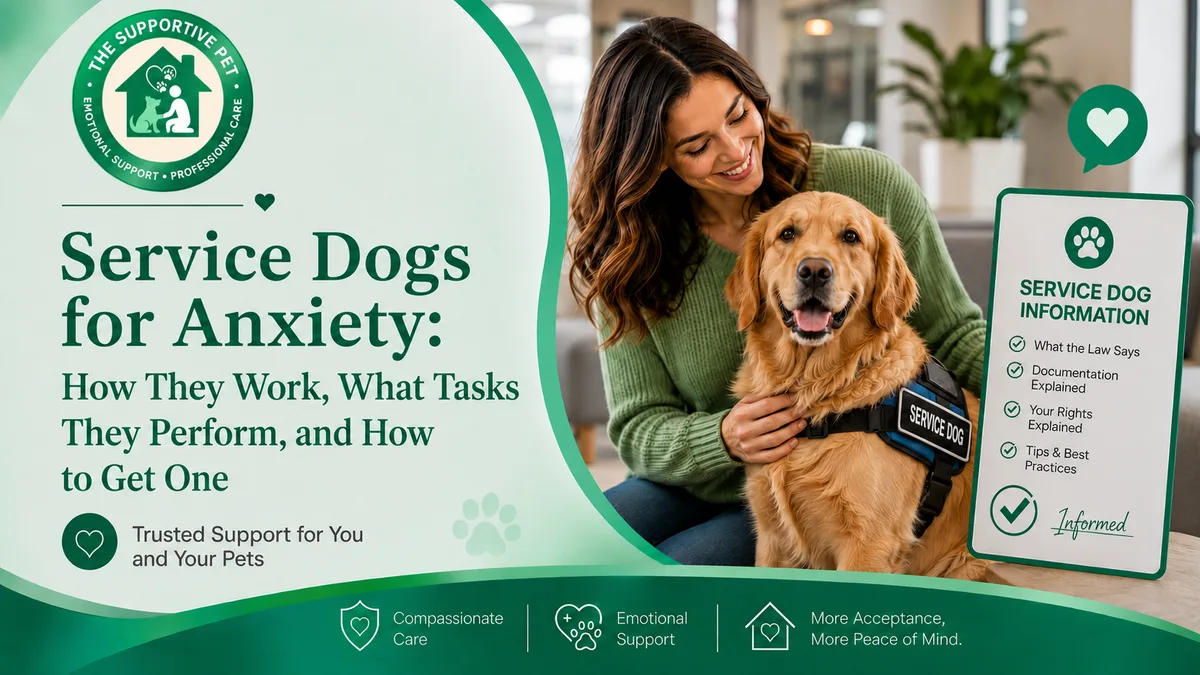
Can you get a service dog for anxiety?
Yes. Anxiety disorders can qualify a person for a psychiatric service dog (PSD) if the anxiety substantially limits one or more major life activities and the dog is trained to perform specific tasks that mitigate the anxiety - such as interrupting a panic attack, performing deep pressure therapy, alerting to pre-anxiety physical signs, or retrieving medication. An ESA for anxiety provides comfort through presence but does not perform trained tasks.
Medical Disclaimer: This article is for informational purposes only and does not constitute medical or legal advice. Consult a qualified mental health professional before making decisions about your care. If you or someone you know is in crisis, call or text 988 (Suicide & Crisis Lifeline, available 24/7).
What Is a Service Dog for Anxiety?
A service dog for anxiety is a dog individually trained to perform specific tasks that mitigate an anxiety disorder or related condition. These dogs are classified as psychiatric service dogs (PSDs) under the ADA, because anxiety disorders are psychiatric disabilities that substantially limit major life activities for the people who have them.
The key legal distinction is the task training. A service dog for anxiety does not simply provide comfort by being present - that would be an emotional support animal (ESA). A service dog for anxiety performs discrete, trained behaviors that directly address the disability. The task training is what gives a PSD its broad legal access rights under the ADA, including the right to accompany their handler to most public places, on housing (FHA), and (as a PSD) potentially in-cabin on flights (DOT rules).
Service Dog for Anxiety vs. ESA for Anxiety: The Key Difference
This distinction matters enormously for your rights:
- ESA for anxiety: Provides therapeutic comfort through presence and companionship. Has housing rights under FHA. No ADA public access rights. No special airline access. Documentation: ESA letter from a licensed mental health professional.
- Psychiatric service dog for anxiety: Performs trained tasks that mitigate the anxiety disorder. Has ADA public access rights (stores, restaurants, transportation). Has housing rights under FHA. May have airline access under DOT rules. Documentation: PSD letter from a licensed mental health professional + possible airline forms.
If your anxiety substantially limits daily functioning and a trained dog could perform tasks that reduce that limitation, a PSD rather than an ESA may be more appropriate. If your dog mainly provides comfort through companionship and does not perform specific trained tasks, an ESA letter is the correct documentation.
Tasks an Anxiety Service Dog Can Be Trained to Perform
The task must be directly related to the disability. For anxiety disorders, recognized tasks include:
- Deep Pressure Therapy (DPT): Lying across the handler's lap or leaning against them during anxiety or panic attacks - the weight and warmth reduces physiological stress responses
- Anxiety alert: Some dogs can detect early signs of anxiety escalation - physical changes in breathing, body language, or scent - and alert the handler before anxiety peaks, allowing time to use coping strategies
- Panic attack interruption: Making deliberate physical contact - pawing, nudging, or climbing onto the handler - to interrupt the dissociation or hyperventilation cycle of a panic attack
- Medication retrieval: Fetching a bag or pill bottle containing as-needed anxiety medication
- Environmental blocking: Positioning between the handler and strangers to reduce physical crowding that triggers anxiety
- Room search (safety sweep): Checking a room or space on cue for handlers with anxiety-driven safety-checking compulsions
- Guide to safe space: Leading the handler to a pre-designated quiet or safe area during an anxiety episode
How to Qualify for a Service Dog for Anxiety
To qualify for a psychiatric service dog under the ADA, you must have a disability - a physical or mental impairment that substantially limits one or more major life activities. Anxiety disorders that commonly meet this threshold include:
- Generalized anxiety disorder (GAD) with significant functional impairment
- Panic disorder with frequent panic attacks that limit daily activity
- Social anxiety disorder that significantly restricts social or occupational functioning
- Specific phobias that substantially limit daily activity
- Anxiety as a component of PTSD, OCD, or other conditions
Not everyone with anxiety qualifies - the severity and functional impact matter. A licensed mental health professional must assess your specific situation and determine whether your anxiety rises to the level of a disability under the ADA/FHA definitions.
Getting a PSD Letter for Anxiety vs. an ESA Letter for Anxiety
Both an ESA letter for anxiety and a PSD letter for anxiety come from a licensed mental health professional who evaluates your mental health needs. The difference is in what the letter documents:
- An ESA letter documents your disability and the therapeutic nexus with your animal - the basis for your FHA housing rights
- A PSD letter documents your disability, the therapeutic relationship, and confirms that you have a legitimate need for a service dog - used to support your ADA public access rights and airline access
See our guide on PSD letter for anxiety for the detailed difference, and ESA vs. PSD letter for when each is appropriate.
How to Get a Service Dog for Anxiety
Option 1: Program placement - Professional service dog organizations train dogs specifically for psychiatric disabilities and match them to handlers. Waitlists are typically 1–3 years, and costs range from $0 (for nonprofit programs) to $50,000+ for professional trainers. Programs include PTSD Foundation, K9s for Warriors, and various regional organizations.
Option 2: Owner training - The ADA explicitly allows owner training of service dogs. This means you can train your own dog (or a dog you adopt) to perform the required tasks. Owner training is cost-effective but time-intensive - typically 18–24 months of consistent training. A professional trainer can help with task training even if the overall program is owner-directed. See our guide on how to owner-train a psychiatric service dog.
Anxiety Service Dogs and ADA Public Access Rights
One of the most significant practical differences between an emotional support animal and a psychiatric service dog for anxiety is public access. Under the ADA, psychiatric service dogs are permitted to accompany their handlers to most places the public is allowed - including restaurants, cafes, retail stores, hotels, workplaces, government buildings, and most public transportation. Businesses and their staff can ask only two questions: (1) Is this a service dog required because of a disability? and (2) What work or task has the dog been trained to perform? They cannot ask for documentation, require the dog to demonstrate the task on the spot, or deny entry based on breed or size.
For people with anxiety, this distinction can be life-changing. Anticipatory anxiety - the fear that a panic attack might occur in public - often causes significant avoidance behavior that progressively narrows daily life. Having a trained anxiety service dog present in grocery stores, on transit, and at work can restore access to spaces that anxiety has made difficult or impossible. An ESA letter does not provide this benefit because ESAs do not have ADA public access rights.
Training Timeline and Cost for an Anxiety Service Dog
Getting a service dog for anxiety is a significant commitment in time and money, regardless of which path you take:
| Path | Timeline | Cost Range | Key Consideration |
|---|---|---|---|
| Professional program | 1-3 years (waitlist + placement) | $0-$50,000+ | Dog fully trained before placement |
| Trainer-assisted owner training | 12-24 months | $5,000-$15,000 | Flexible; handler involved throughout |
| DIY owner training | 18-24 months | $500-$2,000 | Most time-intensive; requires consistency |
The most common mistake new anxiety PSD handlers make is rushing the training timeline. Public access training - introducing the dog to restaurants, stores, transit, and crowds while maintaining task performance - takes months of consistent work. A dog that performs deep pressure therapy perfectly at home but becomes distracted in public settings is not yet ready for public access work. Most experienced trainers recommend a minimum of 120 hours of combined task and public access training before relying on the dog in real anxiety situations.
What the PSD Letter Evaluation Covers for Anxiety
A PSD letter for anxiety differs from an ESA letter in one important way: it must document not just your disability, but your legitimate clinical need for a service dog specifically. The licensed clinician conducting your evaluation will assess:
- Your anxiety disorder diagnosis - confirmed against DSM-5 criteria for GAD, panic disorder, social anxiety, or related conditions
- Functional impairment - how your anxiety limits daily activities like work, travel, or social participation
- The therapeutic nexus - how a trained dog specifically mitigates your anxiety symptoms
- Task specificity - whether your dog is trained (or being trained) to perform discrete mitigating tasks, not just provide comfort
You do not need a fully trained dog to obtain a PSD letter. Many people get documentation during the training process to protect their housing rights while the dog is still learning tasks. What the clinician evaluates is your clinical need for a task-trained dog - the training can continue after the letter is issued. Whether you choose an ESA letter or a PSD letter ultimately depends on how anxiety affects your daily life: if you primarily need housing protection, an ESA letter is the simpler and more affordable choice; if anxiety limits where you can go and having your dog in public spaces would meaningfully restore your functioning, a PSD evaluation is worth pursuing.
Related: PSD letter for anxiety · PSD vs ESA letter · psychiatric service dog tasks · ESA letter for anxiety
Frequently Asked Questions
Can you get a service dog for anxiety?
Yes. Anxiety disorders can qualify a person for a psychiatric service dog (PSD) if the anxiety substantially limits one or more major life activities and the dog is trained to perform specific tasks that mitigate the anxiety - such as interrupting a panic attack, performing deep pressure therapy, alerting to pre-anxiety physical signs, or retrieving medication. An ESA for anxiety provides comfort through presence but does not perform trained tasks.
What is the difference between a service dog for anxiety and an ESA for anxiety?
A service dog for anxiety (psychiatric service dog) performs specific trained tasks that directly mitigate the disability - interrupting panic attacks, performing grounding behaviors, alerting before anxiety peaks. An emotional support animal for anxiety provides comfort and companionship through its presence, which is therapeutic but not task-based. PSDs have broader public access rights under the ADA; ESAs have housing rights under the FHA but no ADA public access rights.
What tasks does an anxiety service dog perform?
Common tasks anxiety service dogs perform include: deep pressure therapy (lying on or leaning against the handler during anxiety episodes), alerting to anxiety before it peaks by detecting physiological changes, interrupting panic attacks by making physical contact, retrieving anxiety medication, creating physical space in crowded environments, performing room searches to address safety-checking compulsions, and waking the handler from nightmares.
How do I get a service dog for anxiety?
There are two main paths: (1) apply to a service dog program that trains and places dogs for anxiety/psychiatric disabilities - these programs often have long waitlists and costs ranging from $0 to $50,000+; (2) owner-train a psychiatric service dog yourself, with or without a trainer's help. Owner training is legal under the ADA for psychiatric service dogs. You will also want a PSD letter from a licensed mental health professional to support your public access and housing rights.
Can any dog breed be a service dog for anxiety?
Technically yes - the ADA does not restrict service dogs to specific breeds. In practice, certain breeds (Labrador Retrievers, Golden Retrievers, Standard Poodles, Border Collies) are more commonly trained as service dogs because of their temperament, trainability, and size. The dog's individual temperament and trainability matter more than breed. A calm, focused dog of any breed can be trained as a psychiatric service dog.
See our articles highlighted in Google Search
Add The Supportive Pet as a preferred source - your results, your way.