
Does a PSD letter give housing rights?
Yes. A Psychiatric Service Dog letter provides housing protection under the Fair Housing Act, the same as an ESA letter. Your landlord must allow your PSD regardless of no-pet policies, breed restrictions, size limits, or pet deposit requirements. Because a trained PSD also qualifies for ADA public access rights based on the dog's individual task training, PSD handlers typically have broader total legal coverage than ESA holders.
Key Takeaways
- A PSD provides even stronger housing protection than an ESA - landlords must accommodate both PSDs (ADA and FHA) and ESAs (FHA); and trained PSDs also qualify for ADA public access rights based on the dog's individual task training.
- For housing specifically, the documentation requirements for a PSD are the same as for an ESA: a letter from a licensed mental health professional establishing disability and need.
- A landlord may verify that your dog is a trained service animal but cannot require demonstration of tasks or demand certification paperwork that does not exist under federal law.
Medical Disclaimer: This article is for informational purposes only and does not constitute medical or legal advice. Consult a qualified mental health professional before making decisions about your care. If you or someone you know is in crisis, call or text 988 (Suicide & Crisis Lifeline, available 24/7).
A psychiatric service dog letter for housing combines two critical elements: documentation of your psychiatric disability under the Fair Housing Act and documentation of your dog's trained tasks under the ADA framework. For housing purposes, the key protection is the FHA's reasonable accommodation requirement - your landlord must waive pet policies, pet fees, and breed restrictions for your documented PSD regardless of their standard rules. Here is how to use your PSD letter for housing most effectively.
How PSD Letters Work for Housing
A Psychiatric Service Dog letter is functionally equivalent to an ESA letter for housing purposes under the Fair Housing Act. Both give you the right to request a reasonable accommodation for your assistance animal regardless of a landlord's no-pet policy. The difference is that a trained Psychiatric Service Dog also qualifies for ADA public access rights - meaning your dog can accompany you in public places, not just in your housing. The letter documents your clinical need; the ADA rights come from the dog meeting the individual training requirement.
For housing specifically, the process is the same: you submit your PSD letter to your landlord or property management as a reasonable accommodation request, and they must consider it under FHA requirements.
How to Submit Your PSD Letter to a Landlord
Follow these steps when requesting housing accommodation for your PSD:
- Obtain your PSD letter from a licensed mental health professional. The letter must be on the clinician's letterhead, include their license type and number, and state that you have a psychiatric disability and that your dog's trained tasks provide therapeutic benefit related to that disability.
- Write a formal accommodation request. Submit your request in writing - email or certified letter - to your landlord or property manager. Attach your PSD letter and briefly explain that you are requesting a reasonable accommodation under the Fair Housing Act for your Psychiatric Service Dog.
- Document everything. Keep copies of all correspondence. Note the date you submitted your request and any responses you receive. Documentation is your protection if the landlord later claims they were not properly notified.
- Follow up if you do not receive a response within 10 days. Landlords are required to respond to accommodation requests within a reasonable timeframe - typically 10 business days. If you do not hear back, follow up in writing.
For a detailed letter template, see our ESA request letter guide - the same template applies to PSD accommodation requests.
What Your Landlord Can and Cannot Ask
Under HUD guidance, landlords evaluating an assistance animal accommodation request can ask:
- Whether you have a disability that necessitates the accommodation
- Whether the animal provides support related to that disability
- For documentation from a licensed clinician if your disability is not obvious
Landlords cannot ask:
- For your specific diagnosis or medical records
- That your dog demonstrate its trained tasks
- For certification, registration, or ID cards (these are not legally required)
- For detailed information about your psychiatric history
If a landlord is asking for information beyond what HUD allows, cite the 2020 HUD guidance on assistance animals and request that they limit their inquiry to what is permitted. For more detail, see our guide: What can a landlord ask about your ESA?
Handling a PSD Accommodation Denial
If your landlord denies your PSD accommodation request, the process for responding is the same as for ESA denials:
- Request the denial in writing with the reason stated
- Consult your state's fair housing agency for guidance
- File a complaint with HUD at hud.gov - complaints can be filed online and are investigated at no cost to you
- Consult a fair housing attorney - many offer free consultations for FHA cases
See our detailed guide: ESA/PSD letter rejected by landlord - what to do
PSD Letter vs ESA Letter for Housing: Which to Use?
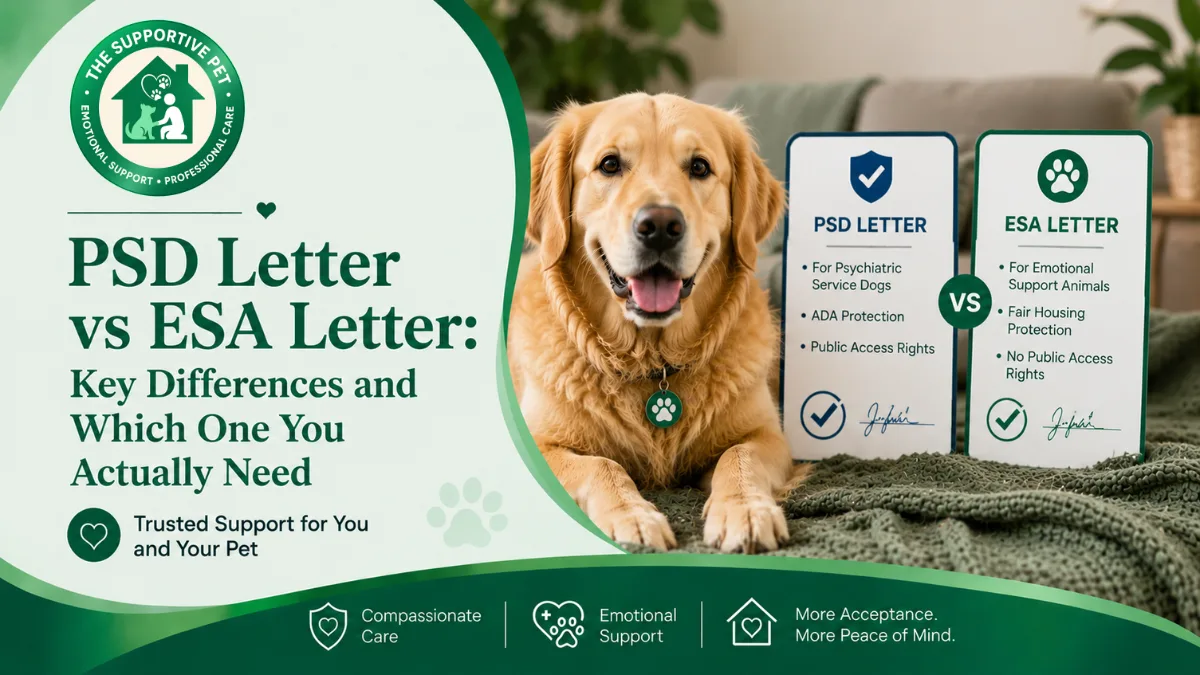
For housing alone, either documentation type provides equivalent FHA protection. Choose based on what you need beyond housing:
- Use an ESA letter if you only need housing protection, your animal is not a dog, or your dog has not been task-trained
- Use a PSD letter if you want the additional benefits of ADA public access rights and DOT air travel rights, and your dog performs specific trained tasks
From the Clinician
When I write a PSD housing letter, I'm navigating the intersection of two separate legal frameworks: the ADA's definition of a service animal and the FHA's broader "assistance animal" accommodations as described in HUD's assistance animal guidance. PSD handlers in housing have stronger protections in some ways - their dog is both a service animal under ADA and an assistance animal under FHA - but landlords often conflate the two and ask for the wrong documentation. I clarify in every PSD housing letter that the animal meets both standards and explain which accommodation request is being made under which law.
Client scenario: A client with schizoaffective disorder was denied housing at a condo complex that argued their no-pets policy applied equally to everyone and that service animal accommodations "only apply to public businesses, not apartments." After I provided a PSD letter explicitly citing both ADA Title II/III definitions and FHA Section 804(f)(3)(B), and after the client submitted a formal reasonable-accommodation request rather than a general service-animal disclosure, the condo board reversed its decision within ten days.
A Fair Look at the Other Side
It's worth acknowledging that housing providers aren't always wrong to scrutinize PSD documentation. The legal standard for PSD housing accommodations genuinely is higher than for ESA letters - a service animal must be individually trained to perform tasks, not merely provide comfort through presence. When housing providers request task documentation or behavioral history, they may be applying the law correctly. The accommodation request works best when handlers and clinicians provide documentation that is specific enough to answer those questions upfront, rather than treating any request for clarity as a denial in disguise.
Related guides: PSD vs ESA letter comparison · ESA housing rights · ESA pet deposit rules
PSD vs ESA for Housing: When Each Makes Sense
ESA Letter for Pure Housing Needs
If your primary or only need is housing accommodation - keeping your dog in a no-pets building or waiving pet fees - an ESA letter accomplishes this at lower cost and with a simpler evaluation. ESA letters do not require documentation of trained tasks, which makes the evaluation faster and less complex. For most people who simply want their dog or cat in their apartment without paying pet fees or facing breed restrictions, an ESA letter is the more efficient choice.
PSD Letter for Housing Plus Public Access
If you need both housing accommodation and public access rights - taking your dog to restaurants, stores, hotels, or other public spaces - a PSD letter provides the legal basis for both. The FHA covers housing, and the ADA covers public spaces: your PSD letter documents compliance with both frameworks in one evaluation. People with severe PTSD, agoraphobia, or panic disorder who need their dog across multiple life contexts often find a PSD letter worth the additional cost and evaluation complexity because it addresses all their needs.
Presenting Your PSD Letter to a Landlord
When submitting your PSD letter to a landlord for a housing accommodation, you do not need to explain the dog's tasks or provide ADA-specific documentation - you are operating under the FHA, not the ADA, for housing purposes. Present the letter as a request for reasonable accommodation under the Fair Housing Act, similar to an ESA letter. Your landlord can ask whether you have a disability-related need for the animal (yes) and whether the animal provides disability-related assistance (yes). They cannot ask about the specific nature of your psychiatric condition, what tasks the dog performs, or demand to see the dog demonstrate its training.
Related: ESA vs. PSD Letter comparison
Frequently Asked Questions
Does a PSD letter give housing rights?
Yes. A Psychiatric Service Dog letter provides housing protection under the Fair Housing Act, the same as an ESA letter. Your landlord must allow your PSD regardless of no-pet policies, breed restrictions, size limits, or pet deposit requirements. Because a trained PSD also qualifies for ADA public access rights based on the dog's individual task training, PSD handlers typically have broader total legal coverage than ESA holders.
Do I need to tell my landlord my dog is a service dog vs an ESA?
You can present your PSD either as a service dog (ADA) or as an assistance animal (FHA) - both protect you in housing. For housing purposes, most landlords are more familiar with FHA/ESA accommodation requests. You can present your PSD letter and simply request a reasonable accommodation under the FHA, which is the same process used for ESA letters. If your landlord is familiar with service dog law, you can also cite ADA and FHA protections together.
Can my landlord charge a pet deposit for a PSD?
No. Landlords cannot charge a pet deposit or pet fee for a Psychiatric Service Dog. PSDs are assistance animals, not pets, under both FHA and ADA frameworks. A landlord who charges you a pet deposit for a documented PSD is violating federal housing law. If this happens, contact HUD to file a complaint at hud.gov/program_offices/fair_housing_equal_opp.
Can my landlord deny my PSD because of breed restrictions?
No. Breed, weight, and size restrictions in lease agreements do not apply to assistance animals - whether ESA or PSD - under the Fair Housing Act. A landlord who denies your PSD accommodation request based on breed is violating the FHA. Document the denial and consult with a fair housing attorney or file a HUD complaint.
See our articles highlighted in Google Search
Add The Supportive Pet as a preferred source - your results, your way.